Is Morocco safe for solo female travellers?
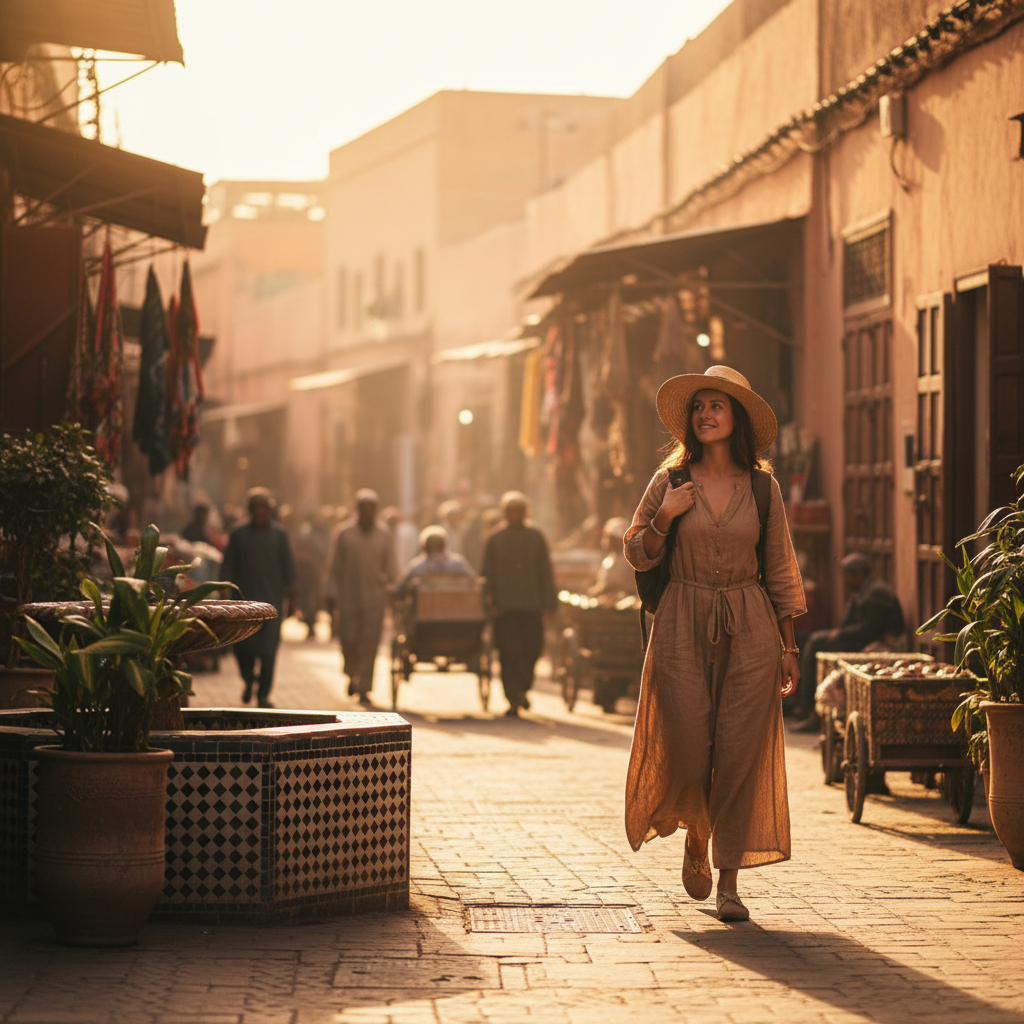
Morocco is a destination many solo female travellers visit successfully, but it is not a place where you should travel on autopilot. The main challenge for many women is not violent danger, but persistent attention: comments in the street, sales pressure, unsolicited help, and the occasional scam aimed at tourists who look uncertain. A sensible approach to Morocco travel safety is to prepare for those moments without letting them define the whole trip.
In Marrakech, the intensity can feel strongest in busy areas such as the medina, souks and main squares. You may be called after, asked where you are going, told a route is closed, invited into shops, or encouraged to accept a “guide” you did not request. Most of this is verbal and transactional, but it can still be draining, especially if it is your first experience of a culture where public interaction is more direct.
The key is to separate discomfort from danger. Feeling watched, approached or over-sold to can be uncomfortable; being followed, blocked, touched, isolated or pressured after you have refused is different. Trust your instincts early. If a situation feels wrong, step into a shop, return to a busier street, call your accommodation, or ask another woman, family or official-looking staff member for help.
The mindset that makes solo travel easier
Solo travel in Morocco is easier when you stop trying to be endlessly polite. You can be respectful without being available to every conversation, invitation or sales pitch. A brief “no, thank you” is enough; you do not need to explain where you are staying, whether you are married, why you are alone, or what your plans are for the day.
It also helps to accept that your trip may feel different from solo travel in quieter destinations. You may plan more carefully, choose taxis more selectively, avoid wandering late at night, or book a guide for your first day in the medina. None of that makes you a nervous traveller. It simply means you are adapting to the place in front of you.
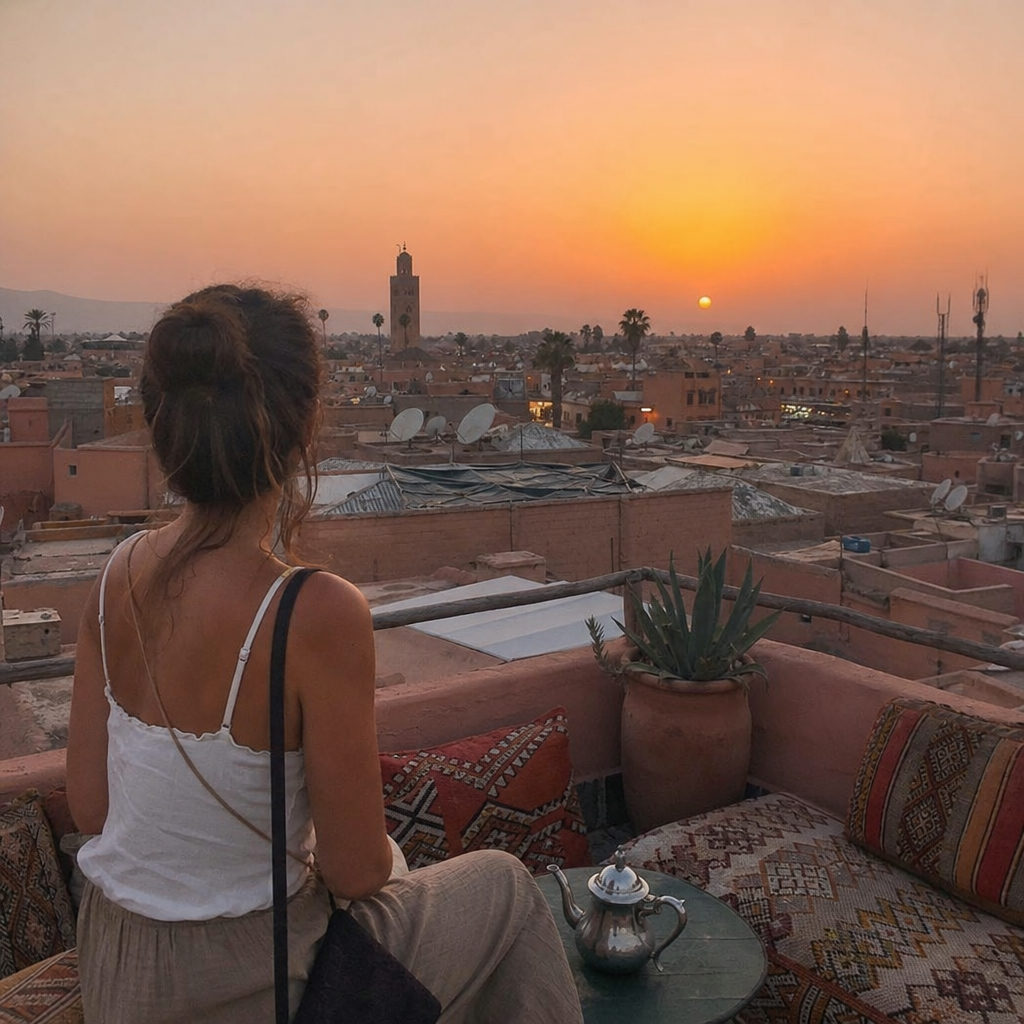
Build recovery time into your itinerary. A riad courtyard, a rooftop café, a hammam, a museum or a calm garden can give you space to reset after a busy morning. Solo female travel is not a test of how much you can tolerate; it is a chance to choose the pace and boundaries that let you enjoy the experience.
Understanding cultural norms around women in Morocco
Travelling as a woman in Morocco means moving through a culture with different expectations around modesty, public behaviour and interactions between men and women. You do not need to pretend to be Moroccan or abandon your own personality, but reading the room will usually make your days smoother. Modesty, calm confidence and clear boundaries go a long way.
Public spaces can feel male-dominated in some neighbourhoods, cafés and transport areas. This does not mean women are absent from Moroccan life, but visitors may notice that men are more visible in certain street settings, especially in the evenings. If you feel exposed sitting alone in a very male-heavy café, choose somewhere with families, couples, women, tourists or a rooftop setting instead.
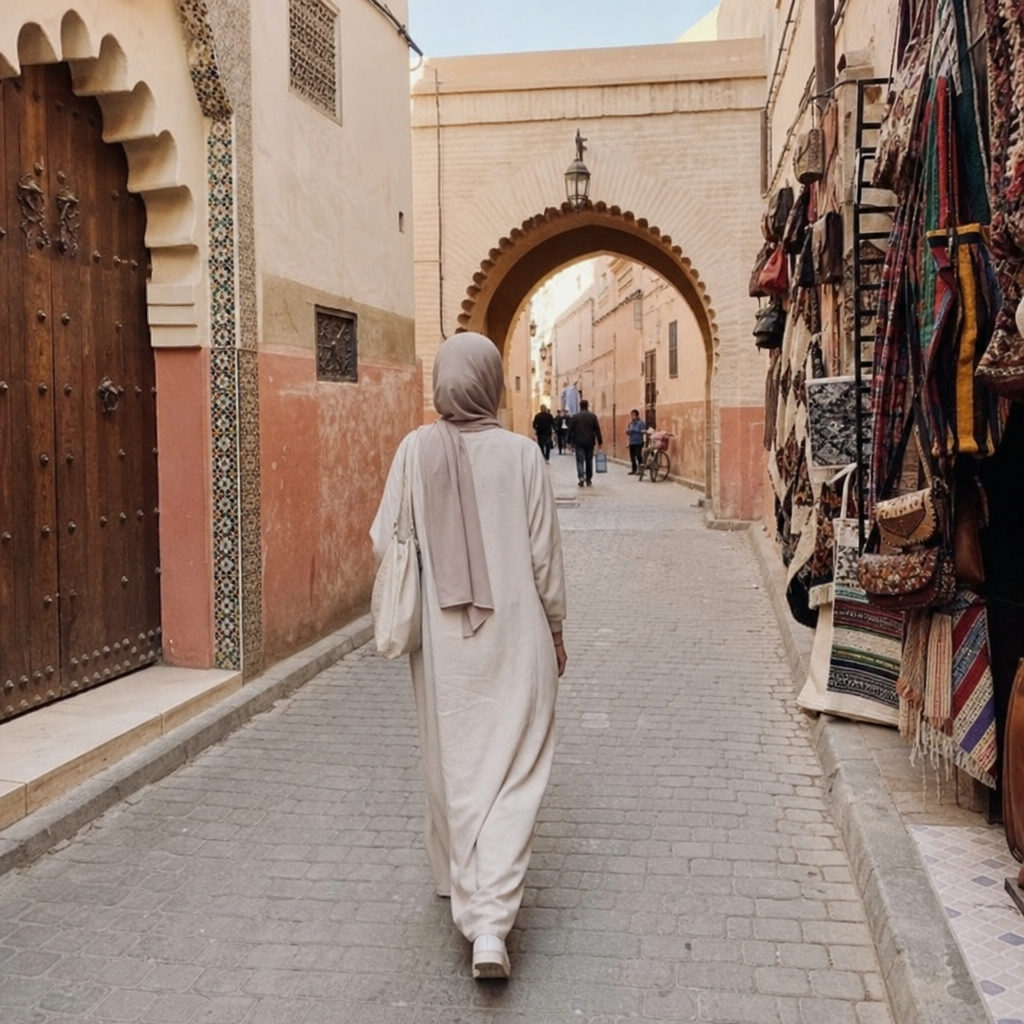
Women in Morocco dress in many different ways, particularly in larger cities, but visitors generally attract less attention when they dress with some coverage. Loose trousers, maxi skirts, linen shirts, long dresses, jumpsuits, light cardigans and scarves are practical as well as respectful. You do not need to cover your hair in most tourist areas, but a scarf can be useful for sun, dust, religious sites, or simply feeling a little less visible.
What should you wear in Marrakech and beyond?
Wear breathable, modest clothing that covers your shoulders, chest and knees, especially in medinas, rural areas and conservative neighbourhoods. This does not guarantee you will avoid attention, but it reduces the sense that you stand out and helps you move through different spaces with fewer worries about local expectations.
For Marrakech, think light layers rather than heavy coverage. A loose cotton or linen shirt over a vest top, wide-leg trousers, a midi skirt, a maxi dress, or a light jumpsuit can keep you comfortable while still feeling appropriate. In summer heat, natural fabrics and looser cuts make a real difference; in cooler months, evenings can call for a jacket or warmer layer.
For coastal towns, mountain villages and desert stops, modesty is still a useful default. Beachwear belongs at the beach or pool, not in town. If you are visiting religious or rural places, avoid sheer fabrics, very short shorts, low necklines and tight outfits that make you feel conspicuous.
A practical packing list might include
Two or three loose tops that cover shoulders and work with different bottoms.
Wide-leg trousers or long skirts for comfort in heat and ease when sitting in cafés or taxis.
A lightweight scarf for sun protection, dusty journeys, conservative settings or extra coverage.
Comfortable closed or supportive sandals because medina lanes can be uneven and busy.
A crossbody zipped bag that sits in front of your body in crowds.
A light jacket or overshirt for evenings, buses, trains and air-conditioned spaces.
Sunglasses and headphones if you find eye contact and comments tiring, though keep enough awareness of your surroundings.
Handling street harassment without losing your confidence
Street harassment is one of the most commonly discussed concerns in any honest Morocco travel guide for women. It can range from comments about your appearance to repeated attempts to start a conversation or walk beside you. Even when it is not physically threatening, the repetition can make you feel tense or irritated.
The most effective response is usually calm, brief and boring. Avoid getting drawn into debates, jokes or explanations. If someone calls out, keep walking. If someone approaches you with unwanted help, say “no, thank you” firmly and continue. If someone persists, use a sharper tone, move towards other people, or enter a business rather than trying to win the interaction.
Some travellers learn a few useful phrases. A firm “la, shukran” means “no, thank you” in Arabic. Some women also use “hshouma”, which roughly communicates shame or inappropriate behaviour, though tone and context matter. You do not need perfect pronunciation; the point is to show that you are not an easy target and that you understand enough to set a boundary.
Real-life scenarios and practical responses
Someone says, “The square is closed, I’ll show you another way.” Keep walking and check your own map. If you need directions, ask your riad, a shopkeeper, a family, or official staff rather than someone who approached you first.
A man walks beside you asking personal questions. Give no details. Say “no, thank you” once, slow down or stop near a busy shop, and let him pass. If he does not, enter somewhere public.
A seller becomes pushy after you look at an item. Smile if you want to, but leave decisively. You are not obliged to buy because you touched, admired or asked a price.
Someone comments on your body or relationship status. Do not engage unless you choose to. A blank expression and continued walking are often more effective than visible annoyance.
You feel overwhelmed in the souks. Step into a café, museum, riad or quieter side street with people around. Reset before continuing, or switch to a guided walk another day.
Your goal is not to be liked by every stranger. Your goal is to move confidently, protect your energy and enjoy the parts of Morocco you came to experience.
Scams and sales pressure to recognise early
Many scams aimed at tourists rely on confusion, politeness or urgency. In Marrakech, a common pattern is the “helpful local” who insists a road is closed, a site is shut, or your destination is in another direction. The help may seem friendly at first, but it can end with pressure for money, a detour to a shop, or an argument about payment.
Another common issue is pricing that changes because you did not agree clearly at the start. This can happen with taxis, unofficial guides, photos, henna, luggage help or small services in busy areas. The safest habit is to agree the price before accepting anything, and to walk away if the person avoids a clear answer.
Street performers, snake charmers, animal handlers and henna artists can also be forceful around payment, especially in tourist-heavy spaces. Do not let anyone put something in your hand, drape anything over you, start drawing on your skin, or take your photo unless you have agreed the price first. If you do want a photo or service, confirm the amount and have small notes ready.
A simple anti-scam checklist
Before accepting help, a ride, a photo, a service or an invitation, pause and ask yourself
Did I ask for this, or did they approach me first?
Have we agreed a clear price before anything starts?
Is this person trying to move me away from a busy area?
Am I being rushed, flattered or made to feel rude?
Can I verify the information with my accommodation, map or official staff?
Would I feel comfortable saying no and leaving right now?
If the answer makes you hesitate, decline. A polite but firm “no” is usually enough, and if it is not, that confirms you were right to disengage.
Transport choices that reduce stress
Transport is one of the easiest areas to organise in advance, and doing so can make your arrival feel far calmer. If you are landing in Marrakech, consider pre-booking an airport transfer through your accommodation or a reputable provider, especially if you arrive late, tired or alone. It removes the need to negotiate immediately after a flight and gives you a direct route to your riad or hotel.
Within Marrakech, the medina is often best explored on foot, but it is not always easy to navigate. Lanes can twist, signs may be limited, and online maps can become confusing in covered souks. For your first day, ask your accommodation for a simple route to the main square, nearby landmarks and the easiest taxi drop-off point. Save the location offline and take a business card or address in French or Arabic if available.
For taxis, ask your hotel or riad to arrange a reputable driver when possible, particularly at night. If you use a street taxi, agree the fare before you get in if the meter is not used, and avoid entering a vehicle if the negotiation already feels uncomfortable. For longer intercity journeys, trains and recognised coach services can be good options, while private transfers may be worth the extra cost for remote routes or awkward timings.
At night, prioritise ease over saving a small amount. A booked taxi, a known route, or a restaurant within walking distance of your accommodation can be a better choice than wandering unfamiliar lanes after dark. Solo travel gives you freedom, but it also rewards decisions that keep the evening simple.
Choosing accommodation that feels safe
Your accommodation can shape the whole trip, especially in Marrakech. A beautiful property in a confusing lane may be charming during the day and stressful when returning alone after dinner. Look beyond décor and check practical details: location, reviews from solo women, staff responsiveness, airport transfer options, clear directions and how easy it is to find after dark.
Riads can be excellent bases because they are usually small, personal and rooted in local design. Many have attentive hosts who can help with taxis, restaurant bookings, tours, hammam visits and route advice. That support can be particularly useful on a first trip, when a quick local explanation can prevent a lot of uncertainty.
Hostels can work well if you want social connection, group activities or budget-friendly tours, but read reviews carefully. Look for comments about cleanliness, lockers, staff, female dorms, quiet hours and the surrounding area. Hotels and resorts can offer more privacy and a softer landing, though they may feel less connected to everyday life in the old city.
Accommodation features worth prioritising
Consistently strong recent reviews from women travellers, especially solo guests.
A location that is central but not chaotic, or clearly reachable by taxi.
Staff who communicate clearly before arrival and can explain how to find the entrance.
Airport transfer or taxi support, particularly for late arrivals.
Secure room locks and luggage storage so you are not worrying about valuables.
A calm common area or rooftop where you can rest between outings.
Breakfast on site, which makes the first part of the day easier and reduces decision fatigue.
Do not underestimate how much emotional safety matters. A place that feels welcoming, easy to return to and staffed by people you trust can make the difference between feeling resilient and feeling worn down.
Staying connected and prepared
Reliable phone data is not just convenient; it is part of your safety plan. It helps you navigate, translate, contact your accommodation, check transport options and share your location with someone you trust. Many travellers arrange a local SIM at the airport or soon after arrival because generous data packages can be better value than international roaming.
Before you leave home, download offline maps, save your accommodation details, and screenshot key addresses, booking confirmations and emergency information. Keep copies of your passport and insurance documents somewhere secure online and offline. If your phone is lost or your battery dies, you do not want every important detail to disappear with it.
Carry a portable charger on long days and keep your phone tucked away in crowded areas when you are not using it. A zipped crossbody bag worn in front is more practical than an open tote. Split your cards and cash so one missing wallet does not become a crisis, and keep a backup card separate from your daily purse.
It is also wise to share a loose itinerary with someone at home. You do not need to report every move, but a simple message when you change city, join a tour or head into the desert gives another person context if plans shift unexpectedly.
Eating, drinking and looking after your health
Food is one of the pleasures of travelling in Morocco, from tagines and couscous to fresh bread, olives, dates, mint tea and market snacks. The aim is not to avoid local food, but to choose it well. Busy places with high turnover are often a safer bet than quiet stalls where food has been sitting around.
Be cautious with tap water, ice, unwashed raw produce and anything that looks as though it has been exposed for a long time. Carry hand sanitiser, especially for markets and street food, and pack basic stomach remedies just in case. If you do feel unwell, rest early, drink safe fluids, and do not force yourself through a packed sightseeing day.
Eating alone can feel awkward at first, but it becomes easier when you choose the right setting. Rooftop restaurants, riad dinners, casual cafés and places with other travellers can feel more comfortable than very formal or heavily male spaces. If you feel self-conscious, take a book, sit with a view, or make lunch your main solo meal and choose dinner closer to your accommodation.
Balancing independence with guided experiences
You do not have to choose between being an independent traveller and joining organised activities. In Morocco, occasional guided experiences can make solo travel richer, safer and more relaxed. A good walking tour can help you understand the medina layout, learn how to handle souk interactions, and spot details you would miss alone.
Group day trips can also be useful for destinations that involve long drives, mountain roads or rural stops. They give you company, structure and a guide who can manage logistics. For some travellers, this is the ideal balance: wander independently in places that feel manageable, then use tours for more complex routes.
If you prefer a female guide, women-led tour companies, local guide directories, hostel recommendations and accommodation contacts are good places to start. Do not assume every recommendation is perfect; ask practical questions about group size, pick-up points, what is included, and whether you will be dropped back at your accommodation or a central meeting place.
When a tour is especially useful
Consider booking a guide or group experience when
You have just arrived and feel disorientated. A first-day medina walk can make the city feel less confusing.
You want to shop in the souks without constant pressure. A guide can help with context, though you should still decide your own budget.
You are visiting remote places. Mountains, desert routes and rural villages can be easier with transport arranged.
You want social time. A cooking class, food tour or day trip can break up long solo stretches.
You feel tired of managing every interaction alone. Letting someone else handle logistics for a day can be worth it.
Where to go beyond Marrakech
Marrakech is often the starting point, but it is not the whole story. If you have time, adding another destination can give you a more rounded view of the country and a welcome change of pace. Each place has its own rhythm, so choose based on your comfort level, interests and transport confidence.
Essaouira is a popular coastal option for travellers who want sea air, a slower medina and a more relaxed atmosphere. It can be a good contrast after the intensity of Marrakech, with ramparts, seafood, galleries and breezy walks by the water. As always, modest clothing remains sensible in town, but the overall pace can feel easier.
Fes offers extraordinary history and craft traditions, but its medina can feel more labyrinthine and intense than Marrakech for some visitors. A guide can be particularly helpful there. Chefchaouen is known for its blue-painted streets and mountain setting, though it involves more travel time, so it suits a slower itinerary.
The Sahara and desert-edge regions can be unforgettable, but choose operators carefully. Long drives, remote camps and mixed-group tours require trust in the company, vehicle, driver and accommodation arrangements. Read reviews, ask where you will sleep, clarify bathroom arrangements, and make sure the itinerary does not leave you arriving somewhere isolated without clear support.
A gentle first-trip itinerary
For a first solo visit, avoid packing too much into each day. Morocco rewards curiosity, but it can also be sensory-heavy: colours, smells, bargaining, scooters, calls to prayer, heat, crowds and constant movement. A slower itinerary gives you room to enjoy it instead of simply coping.
A manageable Marrakech-focused plan could look like this
Day one: arrive and settle in. Use a pre-booked transfer, check in, ask staff for a simple nearby dinner recommendation, and avoid ambitious exploring after dark if you are tired.
Day two: orientate yourself. Take a guided medina walk or follow a simple route from your accommodation to key landmarks. Spend the afternoon somewhere calm, such as a garden, museum or rooftop café.
Day three: choose one deeper experience. Try a cooking class, hammam, food tour, photography walk or souk visit with a guide if you want shopping support.
Day four: take a day trip or slow down. Consider a group trip to the mountains or a quieter day in the city, depending on your energy.
Day five and beyond: add a second destination. Essaouira, Fes, Chefchaouen or a desert route can work if your timing allows, but do not rush long transfers just to tick boxes.
This kind of plan leaves space for spontaneous discoveries while still giving your trip a safe framework. The best first itinerary is not the one with the most stops; it is the one you can actually enjoy.
Money, bargaining and everyday boundaries
Bargaining is part of shopping in many Moroccan markets, but it can feel uncomfortable if you are not used to it. The simplest rule is to only start negotiating if you are genuinely interested in buying. Once you ask prices, handle items and continue the conversation, some sellers may assume you are serious.
Decide your maximum price privately before you get too involved. If the conversation stops being enjoyable, leave. You can be friendly without being pressured into spending more than you planned, and you are allowed to walk away even after several minutes of discussion.
Keep small notes and coins for tips, toilets, snacks and short rides. Avoid showing a large amount of cash when paying, and count change calmly. In crowded markets, put your money away before stepping back into the flow of people.
Boundaries apply to social invitations too. You may be invited for tea, to visit a shop, to see a family business, or to continue a conversation elsewhere. Some invitations are sincere; others are sales tactics. If you want to accept, do so in daylight, in a public or reputable setting, and with a clear exit plan. If you do not want to accept, a simple “no, thank you” is enough.
What to do when something feels wrong
Preparation matters most in the moments when your body tells you to pay attention. Maybe a street is too quiet, a driver changes the plan, a man keeps appearing after you have refused him, or a shopkeeper becomes aggressive. Do not wait until you can prove the situation is dangerous. You are allowed to leave because you feel uneasy.
Move towards light, people and staff. Step into a café, hotel, restaurant, museum, pharmacy or shop. Call your accommodation and ask them to speak to a driver or help you navigate back. If you are in a taxi and feel uncomfortable, ask to be let out somewhere busy rather than continuing into a quieter area.
If you need official help, contact local police or tourist police where available, and involve your accommodation as soon as possible. For serious incidents, your embassy or consulate can advise on next steps, but they are not a substitute for local emergency services. Travel insurance is also important because it can support medical care, lost belongings, cancellations and other problems that are difficult to handle alone.
Your quick safety reset plan
When you feel overwhelmed or unsafe
Stop moving deeper into the situation. Do not follow anyone into a side street, shop back room or vehicle if you are unsure.
Get visible. Move towards families, women, staffed businesses, hotels or main roads.
Communicate. Call your riad, a trusted contact or tour provider and say clearly where you are.
Spend money if it solves the problem. A reliable taxi or nearby café is worth it if it gives you space and safety.
Change the plan without guilt. Return to your accommodation, skip the market, cancel the outing or book a guide for tomorrow.
Confidence is not never feeling nervous. Confidence is knowing you can respond.
The emotional side of being alone in Morocco
Solo female travel in Morocco can bring a mix of wonder and fatigue. One hour you might be admiring tilework, drinking mint tea on a rooftop or watching the light change over rose-coloured walls; the next, you may feel irritated because someone has followed you through a souk asking where you are from. Both experiences can be true in the same day.
Give yourself permission to have complicated feelings. You can love parts of Morocco and still dislike being hassled. You can respect local culture and still protect your personal space. You can be adventurous and still decide that a guided tour, quieter neighbourhood or early night is the right choice.
It helps to create small rituals that bring you back to yourself. Morning coffee on the same terrace, a daily check-in message, journalling, a familiar playlist, or an hour reading in your riad can make the unfamiliar feel manageable. The more grounded you feel, the less each interaction takes from you.
Final takeaways for a first solo trip
Morocco is not the easiest destination for every first-time solo female traveller, but it can be deeply memorable when approached with preparation and self-trust. The best strategy is balanced: dress thoughtfully, stay connected, choose accommodation carefully, manage transport before you need it, and refuse unwanted attention without apology.
Use this morocco travel guide as a starting point, then adapt it to your own comfort level. If you are new to solo travel, begin with a well-reviewed riad, a pre-booked airport transfer and a guided first day in Marrakech. If you are more experienced, you may feel ready to explore further, while still keeping the same core boundaries.
Above all, remember that you are not travelling to prove you can handle every situation alone. You are travelling to experience a country with vivid cities, generous hospitality, rich craft traditions, striking landscapes and a culture that may challenge and reward you in equal measure. Plan well, stay aware, and leave enough space for Morocco to surprise you for the right reasons.