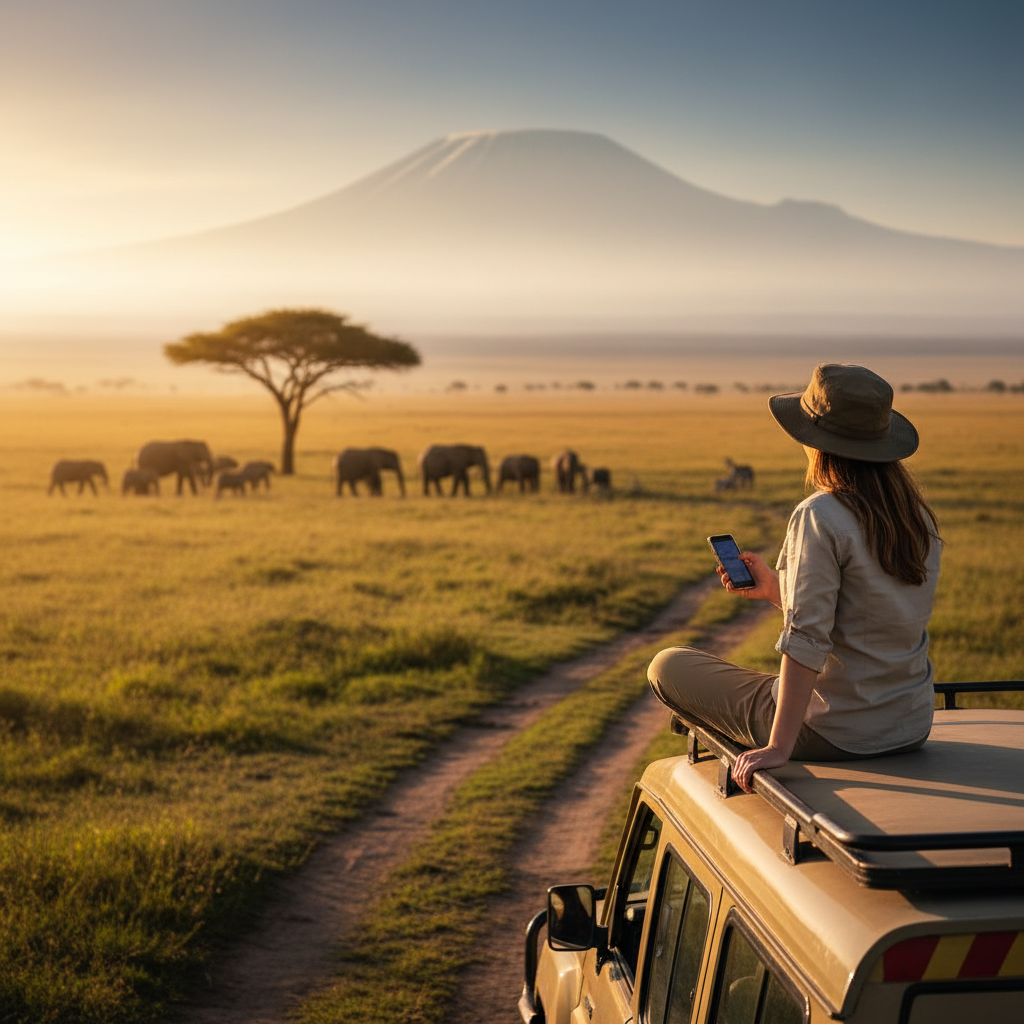
Why Use an eSIM Instead of a Physical SIM Card for a Kenya Safari?
The best eSIM for Kenya is the Safari eSIM Kenya: it offers instant activation, unlimited data options, and access to Safaricom, the mobile network with the widest and most reliable safari coverage in the country. If you’re an international traveler visiting Kenya—especially for safari—and you have an eSIM-compatible phone, it’s the simplest way to get data without dealing with physical SIM cards, airport registration, or roaming charges. Kenya requires passport registration for physical SIM cards, a process at the airport that can take 30–60 minutes, but with an eSIM (embedded SIM)—a digital SIM card built into your device—you can connect directly to a local mobile network and skip the queue entirely. You’ll land with data already active, and dual SIM support lets you keep your primary physical SIM and home carrier active while using a local eSIM on the same device. There’s no paperwork, no need to find a Safaricom shop, and no surprise roaming bills.
For safari travelers, reliable connectivity is what makes mobile data useful in Kenya: you need it for maps, camp coordination, WhatsApp check-ins, and sharing wildlife photos without delays. Safaricom, Kenya’s dominant network, offers the widest coverage across the country, including major cities, rural areas, and key safari routes, and traveler and community reports consistently rate it as the most reliable option in safari regions. In this guide, you’ll see how Kenya eSIMs work, why Safaricom coverage matters, which Safari eSIM Kenya plans and prices make sense for your trip, how to set one up, and what to expect once you’re out in the parks. Signal is usually strongest near lodges, camps, and towns; rural and remote areas are often weaker than cities, and no eSIM can create coverage where the underlying Kenyan network has no tower.
Key Benefits of a Safari eSIM
No SIM Registration: Skip the 30-60 minute passport queues at Jomo Kenyatta International Airport (JKIA).
Safaricom 4G: Connect to Kenya's best network with the widest safari coverage, usually the right plan for safari travel.
Keep Your Number: Your home SIM card stays active for calls and SMS.
Park Coverage: Get a reliable signal at major lodges in Masai Mara, Amboseli, and Tsavo, while Airtel remains a solid option for strong urban 4G/5G coverage across major cities in Kenya.
Safari Mobile Data Coverage: Where Does It Work?
Safaricom covers approximately 96% of Kenya's population and most major safari destinations. Provider choice is crucial for safari travel in Kenya because network strength varies by area. Most eSIMs automatically connect to the strongest available network. Different providers may use either Safaricom or Airtel networks for connectivity in Kenya. While coverage is generally good along main tourist tracks and lodges, remote bush camps and rural sections may drop to 3G or become intermittent, and 4G is standard at the lodge level for reliable coverage.
Pro Tip: Download offline maps before heading out on game drives, as remote sections of the parks can lose signal.
Destination | Coverage | Notes |
|---|---|---|
Nairobi / JKIA | 5G / 4G | Excellent, activate here on arrival |
Masai Mara | 4G at lodges | Seronera & main camps covered; bush weak |
Amboseli NP | 4G / 3G | Good at Ol Tukai Lodge & main areas |
Tsavo East & West | 3G / 4G | Coverage at Voi, Mtito Andei, major lodges |
Lake Nakuru NP | 4G | Strong — near Nakuru town |
Samburu NP | 3G / 4G | Variable; lodges have satellite backup |
Diani Beach / Mombasa | 4G / 5G | Excellent coastal coverage |
Mount Kenya region | 4G | Good in Nanyuki; weaker at altitude |
For safari travel, Safaricom is the strongest option. Airtel Kenya is the second-largest local provider, while Telkom Kenya is a legacy network with less relevance for park coverage. Urban areas across the country usually have fast 4G and increasingly 5G regardless of SIM type, but safari performance still depends on the underlying network.
Kenya eSIM and Safaricom eSIM Plans: Which Should You Choose?
Safari eSIM Kenya plans provide plans ranging from 1GB to unlimited data, with SafarieSIM offering unlimited data from 1 to 30 days on the Safaricom network. In contrast, many other Kenya eSIM options on the market offer plans ranging from 1GB to 20GB. As a guide, 30-day plans are priced around $11.06 for 3GB, $29.70 for 10GB, and $48.18 for 20GB; a 10GB plan for 30 days is about $20.60, and the average cost of data in Kenya is roughly $3.12 per day. GigSky, for example, lists unlimited data plans at $27.54 for 7 days and $71.24 for 30 days, while unlimited data plans in Kenya start at $32 for 30 days. Holafly also offers unlimited data at 5G/4G speeds, and some providers include 1GB backup data monthly at no cost. Here's a quick breakdown:
1–3 Days: Ideal for a weekend trip or a Nairobi stopover. Prices start from $6.90/day.
7 Days: Perfect for a standard safari week, and unlimited data plans are commonly available for 7 days.
14–30 Days: Suited for an extended safari combined with a coastal trip, with unlimited data plans commonly available across this range and often offering the lowest daily rate.
Heavy data users may prefer unlimited data packages, but fair-use policies can still apply.
All plans include hotspot/tethering capabilities for sharing data across multiple devices, and some eSIMs also support shared data use across multiple devices more directly. You can activate your data plan any time within 30 days of purchase. Note that these plans work only within Kenya, and many international travel eSIM options are data-only and rely on VoIP apps for calls, while tourist eSIMs typically do not include access to M-Pesa.
How to Set Up Your Kenya eSIM
Check that your phone or other device is eSIM-ready and ensure you have an internet connection for setup. Review the compatible devices list, including iPhone models, before you proceed, as most modern supported devices can install an eSIM profile using eSIM technology.
Purchase your Kenya plan eSIM online at safariesim.com/esim-kenya before departure for instant digital delivery as a free eSIM-ready setup; travel eSIMs also usually avoid strict KYC compared with local SIM registration.
After purchase, check your email for the eSIM QR code. Setup instructions may also arrive through an app or email guide, and you can check for any notifications from the app or Google Play Store if an update is needed.
Before boarding your flight, go to Settings → Cellular → Add eSIM and scan the QR code to install it on your phone, tablet, or other supported hardware. This easy installation process takes just a few minutes.
Set your Safari eSIM as the primary 'Data' line. Your home SIM will remain active for calls. Check the data-roaming settings on the eSIM line to avoid unwanted charges, and you can switch to a new plan later without inserting a new SIM.
Upon landing at JKIA, your phone will connect automatically, giving you immediate connectivity. The eSIM activates instantly upon arrival in Kenya without any physical card.
It also works across smartphones and tablets, and reduces waste by eliminating plastic cards and packaging.
Note: A Safaricom eSIM can also be set up directly on the Safaricom network at a Safaricom Shop, where activation may require you to authenticate the request with your M-Pesa PIN.
For more details, see the full eSIM installation guide →
Planning Your Kenya Trip?
Does an eSIM work on a Kenya safari?
Yes. Safaricom provides 4G/LTE coverage at most major safari lodges and camps in Masai Mara, Amboseli, Tsavo, Lake Nakuru, and Samburu. While remote bush areas may have 3G or no signal, lodge-level coverage is generally reliable.
What network does Safari eSIM use in Kenya?
Safari eSIM connects to Safaricom—Kenya's #1 network by coverage and subscribers. Safaricom has the best park coverage of any Kenyan carrier.
Do I need to register a SIM in Kenya?
Physical SIM cards in Kenya require biometric registration with your passport, a process that can take 30–60 minutes at the airport. An eSIM bypasses this entirely and activates digitally before you travel.
Can I use my phone as a hotspot?
Yes. All Safari eSIM Kenya plans include hotspot and tethering at no extra cost, which is perfect for sharing your connection with travel partners and to connect multiple devices. Some providers also offer shared data plans for multiple devices, which can be useful on trips covering several stops instead of buying multiple plans.
How much data do I need for a one-week safari?
For moderate use (navigation, photos, WhatsApp, occasional streaming), 7–10GB is a comfortable amount for a week. However, Safari eSIM Kenya plans include unlimited data, so you don't need to worry about hitting a cap.
Ready for Your Kenya Safari?
Get reliable Safaricom 4G coverage from just $0.99/day. Enjoy instant QR code delivery, activate before your flight, and stay connected throughout your journey; many international travel eSIMs are data-only, so calls are usually handled through apps like WhatsApp or Facebook Messenger, making this a strong choice for your next trip to Kenya. This is an ideal solution for all travelers, including long-stay volunteers.