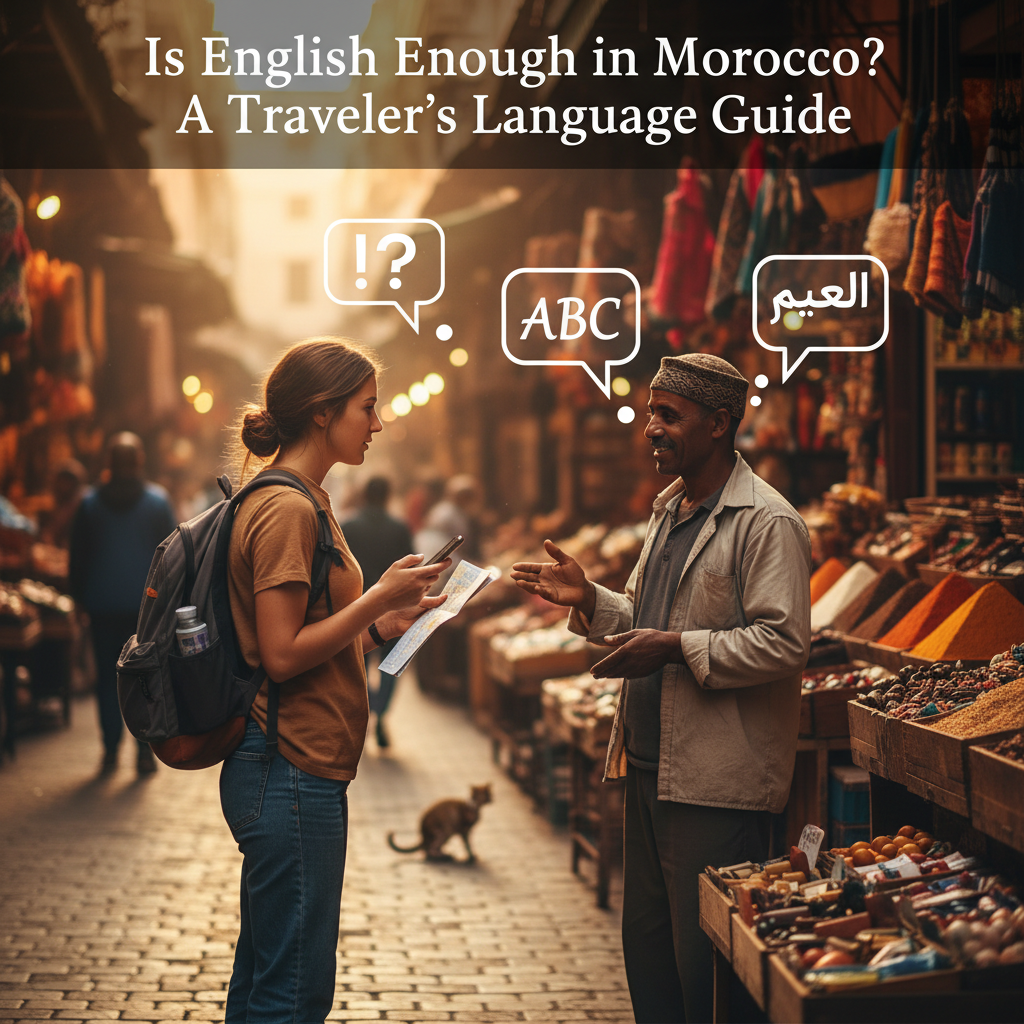
For most trips, yes — speaking English in Morocco will get you through hotels, riads, guided tours, airports and the main tourist areas of Marrakech, Fez, Chefchaouen and Agadir without much trouble. Outside those bubbles, French and Moroccan Arabic (Darija) do the heavy lifting, so a handful of phrases and a translation app on your phone make the difference between managing and genuinely getting around.
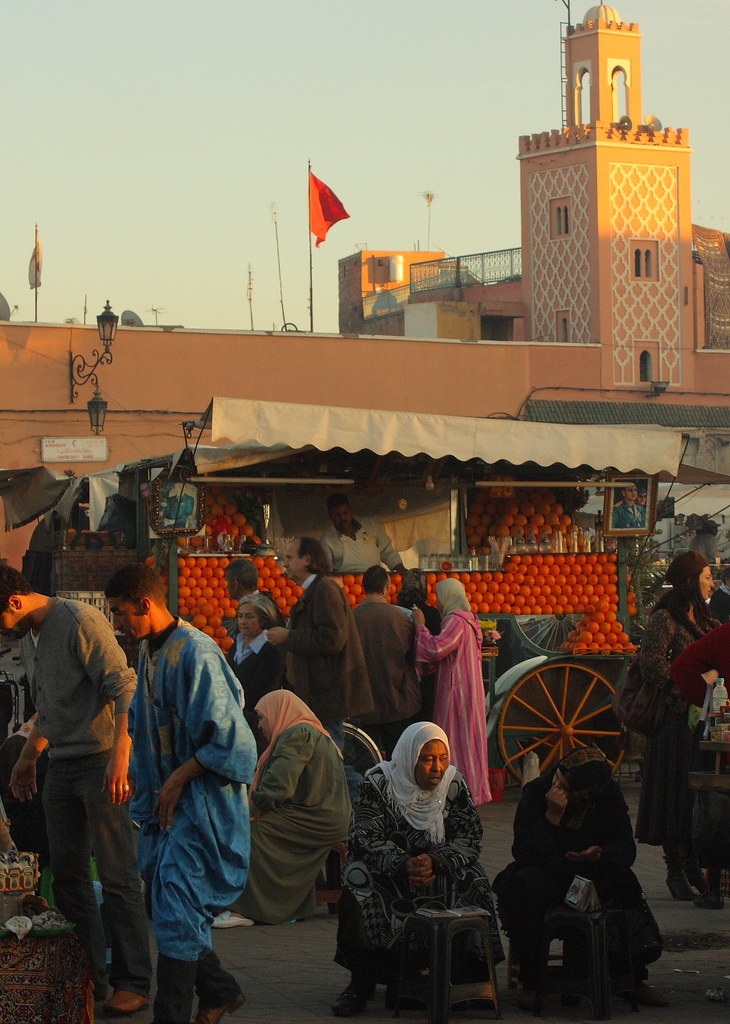
A lively souk in Marrakech, where vendors often speak some English to tourists. — Photo: austinevan / Openverse (CC BY)
Expect a sliding scale rather than a yes-or-no answer. Younger staff in cafés, surf camps and souvenir shops often speak confident English; grand taxi drivers, bus station clerks, small-town grocers and rural guesthouse owners frequently don't. Menus and road signs lean heavily on Arabic and French.
That's also why a working data connection matters more here than in many destinations — a Morocco eSIM keeps offline maps, translation and messaging running from the moment you land.
Yes — in the places most visitors actually spend their time. Riad staff, tour guides, souvenir sellers in the Marrakesh souks, surf schools in Taghazout and desert camp operators near Merzouga almost all handle English comfortably, often alongside French, Spanish and a little German. Younger Moroccans working in hospitality tend to speak quick, confident Moroccan English picked up on the job and from streaming, so conversations rarely stall.
Where English thins out is everyday Morocco: grand taxi ranks, rural bus stations, pharmacies in small towns, post offices and most government counters. Darija and French run daily life there, and a dozen memorised phrases will do more for you than fluent English. Download offline maps and translation before you travel — a Morocco eSIM keeps the translator working in the medina where free Wi-Fi does not reach.
Is Morocco tolerant of homosexuality?
Morocco is not tolerant of homosexuality in law. Article 489 of the Penal Code criminalises same-sex relations and carries possible prison sentences. Attitudes are more relaxed in parts of Marrakesh and Tangier, but LGBTQ+ travellers generally stay discreet in public, and hotels may ask about room arrangements.
Is Morocco tolerant of homosexuality?
Same-sex relations remain illegal under Article 489, carrying prison terms of up to three years, though prosecutions of foreign tourists are rare. Major cities show more tolerance than rural areas — Marrakesh and Tangier have established gay-friendly riads and cafés — but public displays of affection draw attention regardless of orientation, and discretion remains the safer approach. Some hotels still question unmarried couples sharing rooms.
Where English Works Well: Cities and Tourist Areas
English travels well along Morocco's tourist spine. In Marrakech, staff in riads, guides, café waiters around Jemaa el-Fnaa and most souk traders handle it comfortably — often alongside French, Spanish and a few words of Italian or German, picked up from years of dealing with visitors rather than from a classroom.
Tangier leans more towards Spanish because of its Strait crossings, but hotel receptions and the ferry terminal cope fine in English. Casablanca is Morocco's business city, so English is widely spoken in corporate offices, airport services and the newer cafés in Maarif, though an older shopkeeper in the Habous quarter may switch straight to Darija or French.
Reliably English-friendly: riad and hotel reception, licensed guides, airport desks, car hire counters, surf camps in Taghazout and Essaouira.
Hit and miss: grand taxis, pharmacies, local bus stations, neighbourhood restaurants away from the medina.
Having data helps everywhere else: a Morocco eSIM means translation apps and offline maps work the moment you land, not after you find Wi-Fi.
What Languages Do Moroccans Actually Speak?
Day to day, the language you'll hear most is Darija — Moroccan Arabic, a spoken dialect peppered with Amazigh, French and Spanish borrowings. It's different enough from Gulf or Egyptian Arabic that speakers from elsewhere in the Arab world sometimes struggle with it.
Alongside Darija, Amazigh (Berber) is spoken by millions, mainly in three regional varieties: Tashelhit in the Souss and Anti-Atlas, Tamazight in the Middle Atlas, and Tarifit in the Rif. It became an official language under the 2011 constitution, which is why you'll see the angular Tifinagh script on road signs and ministry buildings.
Modern Standard Arabic is the written and formal register — newspapers, the news bulletin, legal documents — but nobody orders mint tea in it. French remains the language of business, banking, higher education and most restaurant menus in cities, a legacy of the protectorate years. In the north, Spanish lingers around Tangier, Tetouan, Chefchaouen and Nador.
Download offline phrase packs before you travel, or keep a Morocco eSIM active so translation apps work in the souk.
How many English speakers are there in Morocco?
There is no tidy census figure for this, and anyone quoting a precise percentage is usually guessing. Morocco's official language statistics track Arabic, Amazigh and French far more closely than English, so what we're left with is a picture built from classrooms, job adverts and street-level experience.
Discretion in public spaces is common advice for LGBTQ+ travellers in Morocco.
How many English speakers are there in Morocco?
Estimates generally place English speakers in the minority — a clear step behind French — but the share is rising fast and skews young. Expect confident English from university students, hotel and tour staff, and people under 30 in cities; far less from older shopkeepers, rural communities and taxi drivers. Education ministry reforms have pushed English deeper into secondary schooling, so the gap between a 19-year-old and a 55-year-old can be enormous.
Practically, that means your odds depend less on national averages and more on who you're standing in front of. A translation app bridges the rest, which is why many travellers arrive with a Morocco eSIM already active rather than hunting for Wi-Fi mid-conversation.
Where English Runs Out: Rural Areas, Souks, Taxis and Small Towns
Step away from the tourism corridor and the English thins out fast. In High Atlas villages around Imlil and Aït Bougoumez, in the Rif towns north of Chefchaouen, or in Saharan-edge places like Rissani and Zagora, your conversation partner may speak Tashelhit or Tarifit first, Darija second and French third — English a distant fourth. Guesthouse owners and trekking guides are the exception, because they deal with visitors daily; the shopkeeper, the bus station clerk and the pharmacist usually do not.
Souks are a special case. A Marrakech or Fès vendor can sell in six languages, but only the selling part: "very good price, come look, how much you pay?" Push into fabric origin, repairs or posting something home and the exchange stalls. Grand taxi drivers are similar — destination and fare in Darija or French, nothing more. Petit taxi drivers rarely speak English at all, so write your address down in Arabic script.
This is where everyday data earns its keep. An active Morocco eSIM lets you translate a pharmacy label, confirm a bus time or show a driver a pinned location without hunting for café Wi-Fi.
Essential Darija and French Phrases That Smooth Every Interaction
You don't need fluency — you need about ten phrases. Moroccans tend to respond warmly to any attempt at Darija, and a greeting in Arabic often shifts you from "tourist to be quoted a high price" to "guest worth a proper conversation". Keep these on your phone or a scrap of paper:
Salam alaikum — the universal greeting; reply wa alaikum salam.
Shukran — thank you. La shukran — no thank you, the politest way to decline a shop invitation.
Bshhal? — how much? Ghali bezzaf — too expensive.
Afak — please. Smahli — excuse me.
Safi — enough / that's it, useful for ending a haggle or stopping a taxi.
French fills the gaps Darija can't: l'addition, s'il vous plaît in a café, où est la gare? at a station, numbers for prices in Casablanca and Rabat shops. Waiters, pharmacists and hotel staff switch to it instantly.
For everything else, a translation app with offline Arabic downloaded works well, though live camera translation of menus and signs needs data — one reason a Morocco eSIM earns its keep in the medina.
How Do You Handle Haggling and Prices When There's a Language Barrier?
Bargaining in a souk is less about fluent conversation than about numbers, and numbers travel well. Most sellers in Marrakech, Fez or Essaouira will happily punch a figure into a calculator and hand you the phone, and you punch one back. Morocco uses the same digits you're used to, so a written price is rarely ambiguous. Prices are often quoted in French too — cent cinquante dirhams — so brushing up on French numbers one to a thousand pays for itself within an hour.
A handful of Darija words does the rest. Shhal? (how much?), bezzaf (too much), ghali (expensive) and akhir taman? (final price?) signal that you know the game. Watch for one quirk: older traders sometimes quote in rials, the informal old unit, where 20 rials equals one dirham — if a figure sounds absurdly high, ask for it in dirhams.
Keep a translation app and a currency converter ready; both need data, which is where a Morocco eSIM earns its keep. Travellers who can check a live rate mid-negotiation lose far less to confusion than people guessing.
Translation Apps, Offline Dictionaries and Staying Connected with a Morocco eSIM
Translation apps handle written French and Modern Standard Arabic well, which covers most menus, road signs and museum labels. What they struggle with is Darija, the spoken local dialect, because it borrows heavily from Amazigh, French and Spanish and is rarely written down in a consistent way. Type a phrase, get the Arabic output, then show the screen rather than relying on the audio — pronunciation from an app often lands somewhere no one recognises.
Download the offline French and Arabic language packs before you leave. Camera translation is the genuinely useful feature: point it at a pharmacy label in Casablanca, a bus timetable in Beni Mellal or a handwritten price board in the medina and you get the gist in seconds. A small printed phrasebook still earns its place when your battery dies in a village with no power for hours.
All of this works better with data. A Morocco eSIM gives you coverage from the moment you land, so live translation, ride-hailing and calls to your riad work across the country without hunting for a SIM counter.
Hiring English-Speaking Guides, Drivers and Riads: What to Ask Before You Book
"English-speaking" means very different things depending on who wrote the listing. A Marrakech agency might assign an official, licensed guide who works comfortably in English all day, or it might send a driver whose English covers "hello", "five minutes" and the price. Both get described the same way online. The fix is simple: ask for a short voice note or a two-minute call with the actual person before you pay, not with the booking office. One conversation tells you more than any profile.
Be specific about who speaks what. On multi-day trips to Merzouga or the Dades Gorge, the driver and the camp staff are often different people with different language skills, so ask whether the guide stays with you at the camp or hands you over. For riads, ask whether the night staff speak English too — the owner may be fluent while the person on reception at 11pm speaks only Darija and French.
Finally, confirm the route, stops, waiting time and total price in writing by message. Having a Morocco eSIM active on arrival means you can reach your driver when plans shift, which removes most of the need for complicated explanations in a shared second language.
Is English Enough for Business, Studying or Teaching in Morocco?
For short business trips, English usually holds up. Meetings in Casablanca's finance district, tech firms in Rabat and the offshoring sector all run partly in English, and younger managers are often comfortable switching. But contracts, tax paperwork, bank forms and anything involving a ministry are still written in French or Arabic, so budget for a translator or a bilingual colleague. If you're staying longer — studying at a Moroccan university, interning, or setting up a company — French does the heavy lifting day to day, with Darija earning you goodwill faster than any qualification. Treat learning a few dozen phrases as part of the job, not a hobby.
How much do English teachers make in Morocco?
Pay is modest by European or American standards and is quoted in dirhams per month or per teaching hour. Private language centres pay least, international and private bilingual schools pay noticeably more and sometimes add housing help or a flight allowance. The practical rule: a teaching salary comfortably covers rent in a shared flat, food, transport and weekend travel inside Morocco, but it rarely leaves much to send home or repay student loans. Most employers want a degree plus a recognised TEFL or CELTA certificate, and hours are often split between early mornings and evenings. Business English tutoring for companies, done privately alongside a contract, is where teachers top up their income — and where fluent French helps you win clients.
Is it safe for Americans to go to Morocco right now?
Morocco remains one of the more settled destinations in the region and Americans travel there in large numbers every year, including solo. The realistic risks are pickpocketing in crowded medinas, overcharging by unofficial guides and the occasional aggressive sales pitch — not violence. Check your own government's current travel advice before booking, keep copies of your passport, and stay reachable: a Morocco eSIM means you can call your school, employer or embassy from the moment you land rather than hunting for Wi-Fi.
Cultural Etiquette That Matters More Than Perfect Pronunciation
A badly accented salam alaikum delivered with a smile will get you further than flawless grammar said curtly. Moroccans tend to judge visitors on warmth and patience rather than vocabulary, and that holds true across the country — in a Fès riad, a Rif village café or an international hotel lobby in Casablanca. Greet before you ask. Walking up to a shopkeeper and launching straight into "how much?" reads as brusque, no matter which of the local languages you attempt it in.
A few habits carry real weight: use your right hand to pass money, food or a business card; take your shoes off if your host does; and accept the glass of mint tea rather than waving it away, because refusing hospitality stings more than mangled pronunciation. Ask before photographing people, especially women and older men in rural areas.
Dress is a form of communication too. Covered shoulders and knees in medinas and small towns invite friendlier conversation, something worth knowing if you're travelling solo as a woman. During Ramadan, avoid eating or drinking openly in the street.
A few questions come up again and again from travellers planning a first trip, so here are short, practical answers to round off this guide.
Will English be more widely spoken by 2026?
Slowly, yes. English is now taught earlier in Moroccan schools and dominates tourism training, so under-30s in Marrakech, Agadir and Tangier often speak it more confidently than French. Rural Atlas villages will not change much.
Do I need to learn Arabic script?
No. Road signs carry Arabic and French, and Darija is mostly spoken rather than written. Learning ten spoken phrases beats memorising the alphabet.
What if my translation app stops working mid-conversation?
Download offline Arabic and French packs before you fly, and keep mobile data running with a Morocco eSIM so live translation works in a taxi or souk without hunting for café Wi-Fi.
English will carry you through most of a Moroccan holiday. A handful of Darija greetings, some basic French numbers and a charged phone cover the rest — and the effort is always noticed.