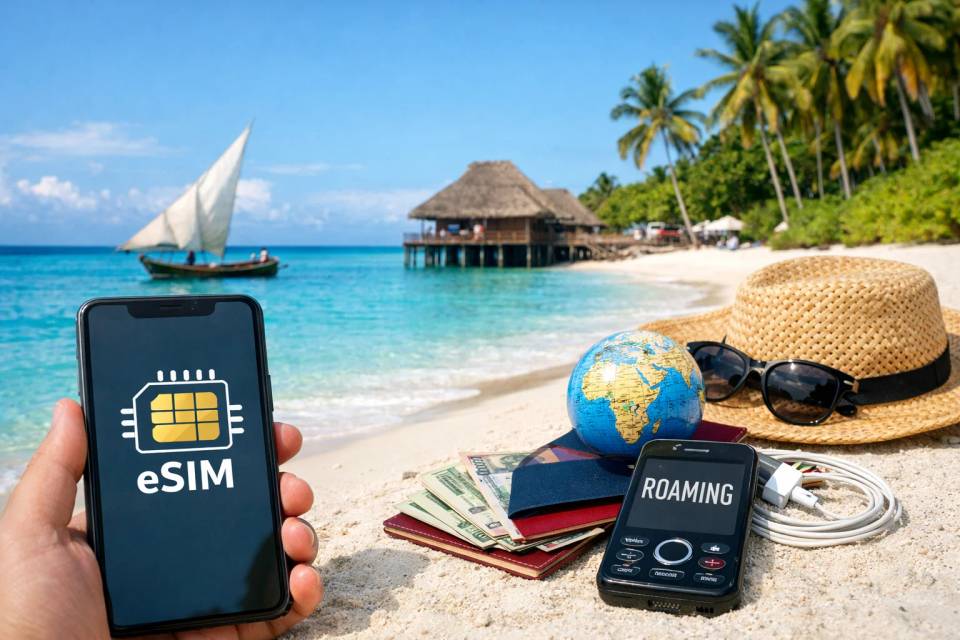
For most travelers, the eSIM Zanzibar vs roaming question comes down to cost and control. A local data eSIM connects you to Tanzanian networks at local-market rates, while your home carrier's roaming plan bills you per day or per megabyte for the same towers. If you're staying more than a day or two, an eSIM is almost always the cheaper and more flexible choice.
For most travelers, the eSIM Zanzibar vs roaming question comes down to cost and control.
If you're staying more than a day or two, an eSIM is almost always the cheaper and more flexible choice.
Roaming still has one real advantage: your usual number keeps working for calls and bank verification texts, with nothing to install.
This guide compares both options on price structure, coverage across Stone Town, Nungwi, Paje and the inter-island ferry routes, activation steps, and what happens to your regular number.
If you already know which way you're leaning, our Tanzania eSIM data plans cover Zanzibar and the mainland on the same profile.
Roaming still has one real advantage: your usual number keeps working for calls and bank verification texts, with nothing to install. An eSIM gives you a separate data line you can activate before you leave home, so you land at Abeid Amani Karume International Airport already connected — no SIM kiosk queue, no passport registration, no swapping tiny plastic cards over a hotel sink.
This guide compares both options on price structure, coverage across Stone Town, Nungwi, Paje and the inter-island ferry routes, activation steps, and what happens to your regular number. If you already know which way you're leaning, our Tanzania eSIM data plans cover Zanzibar and the mainland on the same profile.
Quick Answer: Choose a Tanzania eSIM for Prepaid Data or Roaming for Simplicity
If you want the short version: a travel eSIM wins on cost and control, while roaming wins on doing absolutely nothing before you board. An eSIM is prepaid, so you buy a fixed bucket of data — say 5 GB for a week in Stone Town and Paje — and when it runs out, nothing more gets billed. Roaming usually works the other way around: your home carrier charges a flat daily fee for every calendar day you use the phone abroad, or a steep per-megabyte rate if you have no travel add-on. Three days of accidental background syncing on pay-per-use roaming can cost more than a month of local data.
Deciding between a prepaid eSIM and your home carrier's roaming plan starts before you even reach the airport.
Roaming's real advantage is your phone number. Bank verification codes, airline rebooking texts, and the driver calling to say he's waiting outside the ferry terminal all arrive on your existing line. An eSIM gives you a Tanzanian data connection, not your US number, so texts to your old number won't reach you unless you keep that line active for SMS.
The setup most travelers end up happy with is both: install the eSIM before you fly, let it handle maps, uploads, and calls over the internet, and leave your home SIM switched on for voice and SMS with data roaming turned firmly off. You pay a local data rate, keep your number reachable, and skip the passport-registration queue required for a physical Tanzanian SIM card.
Side-by-Side Table: eSIM vs. Roaming in Africa on Price, Setup, Coverage, and Flexibility
The two options solve the same problem in opposite ways. Roaming extends your home plan into Tanzania and bills you for the privilege, usually as a daily pass or a per-megabyte rate. A travel eSIM is a separate prepaid line that lives alongside your home number, buys local network access up front, and stops when the data runs out. Here's how they stack up on the things that actually matter on a Zanzibar trip.
Factor | Tanzania eSIM | Carrier roaming |
|---|---|---|
Cost model | Prepaid bundle paid before departure; spend is capped at what you bought | Daily pass or metered rate added to your monthly bill after the trip |
Setup | Scan a QR code or install via app, ideally over Wi-Fi at home; a few minutes | Toggle roaming on, or call your carrier to enable international service |
Coverage | Local networks in Stone Town, Nungwi, Paje and the mainland; thinner on remote east-coast stretches | Same physical towers, reached through a roaming agreement |
Calls and texts | Data-first; calls over internet apps | Your usual number rings normally, often at premium per-minute rates |
Flexibility | Top up or add a plan mid-trip; swap plans for a Serengeti extension | Fixed plan terms; changes mean calling support from abroad |
If you're pricing a specific itinerary, compare a Tanzania eSIM bundle against your carrier's daily roaming fee multiplied by your nights on the island — that single calculation settles the question for most travelers.
What Will Mobile Data Actually Cost During a Zanzibar Trip?
Start with how much data you'll genuinely burn through, because that number drives everything else. A week in Zanzibar for most travelers looks like this: checking in with family each evening, pulling up offline-capable maps between Stone Town and Nungwi, booking a dhow trip, and pushing a few dozen photos to the cloud. That's modest — often 3–5 GB across a week. Add video calls home or streaming in the evening and the picture changes fast, since standard-definition video runs roughly 1 GB per hour and HD climbs well past that.
The two pricing models behave differently once you plug those numbers in. Roaming from a US carrier is usually billed as a flat daily fee per line, charged on every day you touch the network — so a 10-day trip costs ten times the daily rate whether you used 50 MB or 5 GB. A prepaid Tanzania eSIM flips that: you buy a fixed data allowance up front for the whole trip, and idle days cost nothing extra.
That difference compounds with group size and trip length. Two phones on daily roaming doubles the bill; two prepaid data plans sized to each person's habits often don't. Short trips of two or three nights are where roaming stays competitive, because the daily charges don't have time to stack up. Anything past about five days, or any trip where someone wants to stream in the evening, generally favors buying data by the gigabyte instead of by the day.
How Does a Travel eSIM Work in Zanzibar? Read the Zanzibar eSIM Guide
A travel eSIM is a digital mobile plan installed on a compatible, carrier-unlocked phone. After purchasing a plan that covers Tanzania, you typically receive a QR code or manual installation details. Add the eSIM while you have reliable internet access—ideally before departure—then wait to activate or use it until you arrive in Zanzibar, according to the plan’s instructions.
Once in Zanzibar, select the travel eSIM as the phone’s mobile-data line. Many plans also require data roaming to be enabled specifically for that eSIM because it connects through a local partner network. This setting does not automatically enable roaming on your regular line. To reduce the risk of carrier charges, turn off data switching and confirm that your home SIM is not selected for cellular data.
Your physical SIM or existing eSIM can usually remain installed for calls and text messages while the travel eSIM handles data. However, answering calls, making calls, or sending standard texts through your home number may still trigger roaming fees. If you do not need that number during the trip, disable the line temporarily rather than removing it.
Before buying, check three details: whether your phone supports eSIM, whether it is unlocked, and whether the plan covers Tanzania rather than only a neighboring country. Also note the activation rule. Some plans begin when installed, while others start when they first connect to a supported network. Knowing that difference prevents the validity period from starting earlier than intended.
How Do You Choose the Right Data Plan? Compare eSIM Tanzania Options and the Best eSIM for Tanzania
Start with three questions: how many days are you on the island, how much data do you realistically burn, and does your itinerary stay in Zanzibar or continue to the mainland? A rule of thumb that holds up well on a beach trip — messaging, maps, email and a few photo uploads a day usually sits in the few-hundred-megabytes range, while video calls home and social posting from Stone Town push it past a gigabyte. Pick a plan one step above your estimate rather than two, since most Tanzania eSIM plans let you top up mid-trip without reinstalling anything.
What Is Better, an eSIM or an International Plan?
For almost every leisure trip to Zanzibar, the eSIM wins on cost and the international plan wins on convenience. If you are there four days, never want to touch a setting, and your employer pays the bill, the carrier add-on is fine. If you are there a week or more, travel with a partner or family, or expect to tether a laptop, a prepaid data plan bought before departure is cheaper by a wide margin and never surprises you on the next statement.
Two details decide the rest. Check that your handset is carrier-unlocked and eSIM-capable before you buy, and check plan validity: a 30-day window covers a safari-plus-beach itinerary, while a 7-day plan priced for a short stay is wasted if your return flight is on day 10. Keep your home SIM active for calls and verification codes, and let the eSIM carry the data.
How Do You Activate an eSIM and Turn On Data Roaming?
Do the setup work at home, on Wi-Fi, before you ever see a departure board. Buy and install your Tanzania eSIM a day or two early, scan the QR code or use the one-tap install link, and give the new line a clear label like "Zanzibar" so you don't confuse it with your home number. Installation and activation are separate steps on most profiles: the data clock usually starts when the eSIM first connects to a Tanzanian network, not when you install it.
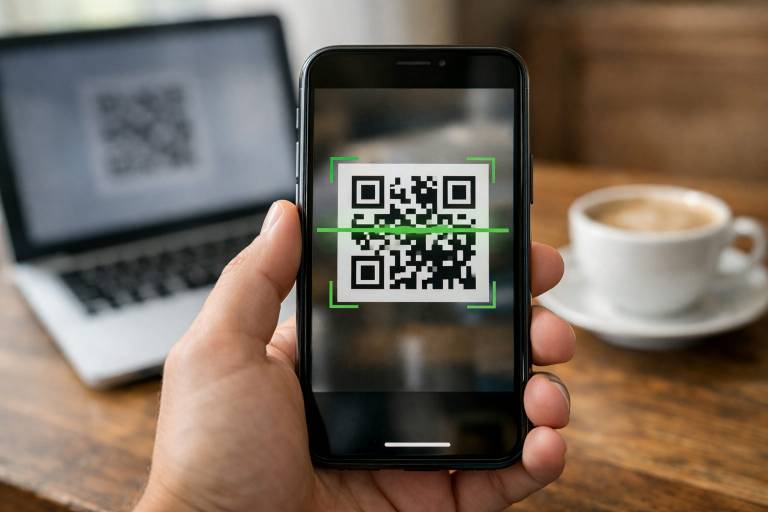
Installing the eSIM at home over Wi-Fi means it's ready the moment you land in Zanzibar.
How do I turn on data roaming on my eSIM?
Open your phone's cellular or mobile data settings, tap the travel eSIM line, and switch Data Roaming to on for that line only. This sounds backwards, but a travel eSIM connects through a local partner network as a visiting profile, so without roaming enabled it registers for signal and then refuses to pass data. While you're there, set the eSIM as your default line for cellular data, leave your home line on for calls and texts if you want to keep your number reachable, and turn off your home carrier's roaming so it can't quietly pick up the slack at per-megabyte rates.
After you land, toggle airplane mode on and off, or restart the handset, to force a fresh network search. If data still doesn't move, check that the APN matches what your provider listed and that "allow cellular data switching" is disabled. Most no-service complaints in Stone Town come down to one of those three toggles, not a bad profile.
Where Can You Expect Coverage Across Zanzibar?
Here's the part travelers often miss: a travel eSIM and your home carrier's roaming plan both ride on the same Tanzanian towers. Neither one builds extra masts for you, so the map of where your phone works is essentially identical — the difference shows up on your bill, not your signal bar. That means the real question isn't which option has better coverage, it's where on the island you'll have service at all.
Stone Town, Nungwi, Kendwa, Paje, Jambiani, Matemwe and the strip around the airport are the most consistently served areas, with 4G typical in town centers and along the main tarmac roads. Signal thins out on the dirt tracks inland, around Jozani Forest, on the Michamvi peninsula tip, and behind the thick coral-stone walls of older Stone Town buildings, where you may drop to a bar or two even in the middle of the city. Out on the water — a dhow sunset cruise, a snorkeling trip to Mnemba, or the mid-channel stretch of the Dar es Salaam ferry — expect long gaps.
Pemba is a different story: coverage clusters around Chake Chake, Wete and Mkoani, and the rest of the island is patchy at best. If you're splitting your trip between the mainland and the coast, a Tanzania eSIM covers both without a second purchase. Either way, download offline maps and your booking confirmations before you leave your hotel's Wi-Fi.
Where Can You Buy a Physical SIM, and Is the Airport the Best Place?
Plenty of travelers still land in Zanzibar planning to grab a local SIM card, and that's a perfectly workable plan — as long as you know what the process actually involves. Tanzania requires every SIM to be registered to an identified person, which means handing over your passport and having your fingerprints captured at an authorized dealer before the line goes live. That rule is why buying from a street vendor with a pre-activated card is a bad idea: unregistered lines get switched off.
Where can I buy a SIM card for Zanzibar?
Your realistic options, roughly in order of reliability
Arrivals hall at Abeid Amani Karume International Airport (ZNZ) — network-branded desks that register you on the spot.
Official carrier shops in Stone Town, plus branches near Darajani Market and Mwanakwerekwe, where staff can register, top up, and troubleshoot.
Registered agent kiosks in Nungwi, Paje, Jambiani and Kendwa — small shops flying a network's colors.
Your hotel's front desk, which will often send someone to a registered agent for you.
Is it better to buy a SIM card at the airport?
It's the fastest option if the desks are staffed, but they follow flight schedules, so a late-night or delayed arrival can leave you with nothing until morning. Airport counters also carry a narrower set of bundles and you're negotiating after a long flight. A town shop gives you more plan choice and real support. If you'd rather skip the queue and the fingerprint paperwork altogether, a Tanzania eSIM is live before you land.
Which Option Fits Your Trip? Five-Day Visits, Longer Stays, Island Hopping, and Work Travel in This eSIM vs. Roaming Africa Guide
Short beach break (3–5 days): You're mostly posting photos, checking a dive booking, and pulling up a restaurant location in Stone Town. A small prepaid data bundle usually covers that comfortably, especially if you lean on hotel Wi-Fi for uploads at night. Daily roaming passes are the expensive route here, because you pay for every calendar day you touch the network — including the arrival day when you land at 11 p.m. and the departure day when you're at the airport by 6 a.m.
Two weeks or longer: The math shifts hard. A multi-week stay on a daily pass means paying that fee 14 or 20 times, while a single larger data allowance on a Tanzania eSIM spreads across the whole trip. Longer stays also mean more map use, more rideshare-style bookings, and more video calls home, so buy a plan with room to top up rather than one you'll exhaust by day nine.
Island hopping and mainland combos: If Zanzibar is one leg of a route that includes Arusha, the Serengeti, or Pemba, pick a plan that covers mainland Tanzania too, not an island-only product. Switching profiles between legs wastes time you'd rather spend on a boat.
Work travel: Keep your home number reachable for two-factor codes and client calls, and run data on the eSIM. That split gives you a reliable hotspot for your laptop without the per-megabyte surprises on your carrier bill.
Common Setup, Billing, and Connectivity Mistakes to Avoid
The most frequent slip-up happens before the plane even lands: installing the eSIM profile while still on home Wi-Fi is fine and recommended, but deleting it to "clean up" your settings is not. Most profiles can only be installed once, and the QR code won't scan a second time. Keep the activation email, and don't remove the line until the trip is over. The second common error is leaving the profile installed but switching data over to the wrong line, which quietly routes a 40-minute video call through your home carrier instead.
Billing surprises almost always trace back to two settings. First, your home line should have data roaming switched off at the line level, not just data turned down — otherwise background photo backups and app updates can run on carrier rates while you sleep. Our cost comparison of eSIM and roaming across Africa walks through how those overnight charges stack up. Second, daily roaming passes often renew automatically at midnight in your home time zone, so a short Stone Town stopover can trigger a charge you didn't plan for.
On the connectivity side, remember that a travel eSIM needs data roaming enabled on its own line, since it connects through a local partner network. Also keep your home SIM active for SMS if your bank sends one-time codes there — calls and texts can stay on that line while data runs over the eSIM. And expect slower speeds on the Pemba ferry route and in Jozani's forest interior; that's geography, not a faulty profile.
FAQ: International Plans, Dual-SIM Use, Hotspots, Phone Numbers, and Switching Back to Your Main Line
Most questions about data in Zanzibar come down to the same worry: will anything break on your home line if you add a travel plan? In practice, nothing does. A data-only Tanzania eSIM sits alongside your existing SIM as a second profile, carries its own local data allowance, and leaves your home number untouched as long as you keep roaming switched off for that line.
The one habit worth building is checking which line is set as "mobile data" before you leave the hotel. Phones default back to the primary line after some updates and restarts, and that is how people rack up roaming charges while sitting on a beach with a perfectly good travel plan installed.
Battery is the other practical limit. Hotspotting two laptops over a 4G signal in Nungwi drains a phone fast, so bring a power bank for day trips and ferry crossings.
Can I keep my home number active while using a travel eSIM?
Yes. Leave voice and SMS on your home line, turn off its data roaming, and route all data through the travel profile.
Does a travel eSIM give me a Tanzanian phone number?
Usually not. Data-only plans skip local numbers, so calls and texts run through internet-based apps instead.
Can I share the connection as a hotspot?
Most plans allow tethering for a laptop or a travel partner's phone, which is handy in lodges with weak Wi-Fi.
How do I switch back when I get home?
Set your home line as default data, then delete the travel profile once the allowance expires.