
The Real Cost of Roaming in Africa
Most US, UK, and European carriers charge a flat daily rate for international roaming, often on top of your monthly plan. Here's what you'd typically pay:
Carrier | Africa Roaming Cost | 7-Day Trip Total |
|---|---|---|
AT&T (USA) | $10/day | $70 |
T-Mobile (USA) | $5/day (Go5G+) | $35 — but throttled |
Verizon (USA) | $10/day | $70 |
EE (UK) | £2/day (in-plan) or £5+ extra | £14–£35 |
Vodafone (UK) | £2–£5/day | £14–£35 |
Telstra (Australia) | AUD $5–$10/day | AUD $35–$70 |
Rogers (Canada) | CAD $12–$15/day | CAD $84–$105 |
Rates approximate and vary by plan. Many roaming plans also throttle data after a daily limit.
Safari eSIM Cost by Destination
🇰🇪 Kenya
$0.99/day
from $5.99 / 7 days
Network: Safaricom
🇹🇿 Tanzania
$2.49/day
from $14.99 / 7 days
Network: Vodacom & Airtel
🇿🇦 South Africa
$1.99/day
from $11.99 / 7 days
Network: Vodacom
🇺🇬 Uganda
$2.49/day
from $12.99 / 7 days
Network: MTN & Airtel
All plans include unlimited data + hotspot. No throttling, no daily caps.
Head-to-Head: 7-Day Kenya Safari
International Roaming
$70–$105
AT&T/Verizon style — often throttled after daily limit
Safari eSIM
from $5.99
Unlimited, full Safaricom 4G speeds, no caps
Local SIM (Kenya)
$3–$8
Cheapest but requires passport registration on arrival
Beyond Cost: Other Reasons to Choose eSIM
Local network speeds
Roaming often gives you slower priority on the network. eSIM connects you as a local user on Safaricom, Vodacom, or MTN — full 4G priority.
No bill shock
Roaming can rack up unexpected charges. eSIM is a fixed daily rate — you know exactly what you're paying.
No SIM registration queues
Arriving in Nairobi or Johannesburg and queueing for a local SIM takes 30–60 min. eSIM is already active.
Keep your home number
eSIM is a second data-only line. Your home SIM stays active for calls and 2FA codes.
Works across countries
Visiting Kenya + Tanzania? Get separate eSIMs for each — often still cheaper than roaming both.
When Roaming Makes Sense
Roaming can make sense if
• You're on a 1-day layover and only need light data
• Your carrier includes Africa in a plan you're already paying for
• You travel constantly and want one solution for all countries (T-Mobile Magenta Max, Google Fi)
For trips of 3+ days in Africa, a dedicated travel eSIM almost always wins on cost and performance.
The Difference Between eSIM and Data Roaming
Before you compare prices, it helps to know what you are actually buying. Data roaming is your home mobile plan borrowing a foreign network: your carrier signs a wholesale deal with an operator in Africa, adds a margin, and bills you a daily fee. An Africa eSIM is a digital SIM card profile you download onto your phone before you travel, buying data directly from the local network at local rates — no middleman markup.
The practical difference shows up in speed. When you use data roaming, your phone is a guest on the network and often sits lower in the priority queue, so your internet slows down exactly when the tower is busy. With a travel eSIM, your phone is treated much more like a local subscriber on Safaricom, Vodacom, MTN or Airtel, which usually means faster mobile internet, better indoor coverage and fewer dead spots on long drives between parks.
The second difference is what you keep. Roaming keeps your home number live for calls and SMS. Most travel eSIM plans are data-only, which is why many travellers run both: the physical SIM card stays in place (roaming switched off) to receive calls and 2FA codes, while the eSIM carries all data. You stay connected on two lines at once and pay for only one of them.
Africa Travel eSIM vs International Roaming: Side by Side
What matters | Africa eSIM | International roaming |
|---|---|---|
Typical cost | $0.99–$2.49/day, unlimited data | $5–$15/day per line |
Speed priority | Local-subscriber priority, full 4G/LTE | Guest priority, frequently throttled |
Setup | Install by QR code in 5 minutes, before you fly | Enable data roaming, no install needed |
Bill certainty | Prepaid and fixed — you cannot overspend | Post-paid, overage risk on calls and data |
Multi-country trips | Regional plans or one eSIM per country | One rate, but per-day fees stack up fast |
Voice calls | Data-only; use WhatsApp, FaceTime or Wi-Fi calling | Native calls and SMS on your own number |
Plan lengths | 7 days, 15 days, 30 days and longer | Charged per day for the whole trip |
If you need native voice on your home number for work, roaming still has a role. For everything else — maps, bookings, uploads, video calls, hotspotting a laptop — an eSIM is the cheaper and faster way to get online in Africa.
Kenya, Tanzania, South Africa, Uganda: eSIM and Roaming Costs Compared
Here is the same trip priced two ways, using typical US carrier roaming at $10/day against Safari eSIM rates. These are the four countries most travellers ask about, and the gap widens with every extra day.
Country | eSIM 7 days | eSIM 15 days | eSIM 30 days | Roaming 30 days |
|---|---|---|---|---|
Kenya (Safaricom) | from $5.99 | ~$14.85 | ~$29.70 | $300 |
Tanzania (Vodacom/Airtel) | from $14.99 | ~$37.35 | ~$74.70 | $300 |
South Africa (Vodacom) | from $11.99 | ~$29.85 | ~$59.70 | $300 |
Uganda (MTN/Airtel) | from $12.99 | ~$37.35 | ~$74.70 | $300 |
Even in the most expensive of these markets, a 30 days eSIM plan with unlimited data costs a quarter of what a month of data roaming does — and in Kenya it is closer to a tenth. Add a second traveller and the saving doubles, because roaming is billed per line while eSIM plans can be hotspotted to a partner's phone, a tablet or a laptop.
How Much Data Do You Need for an Africa Trip?
Many competitors sell fixed buckets, so it is worth knowing what those numbers mean in real use. A 1 GB plan is a light week: maps, WhatsApp text, boarding passes, a few emails. A 3 GB plan suits a normal 7 days trip with daily photo uploads, some Instagram and occasional video calls home. Anything involving Google Maps navigation all day, cloud photo backup, Netflix at the lodge or working remotely will pass 1 GB in two or three days.
This is where capped plans quietly become expensive: a 3 GB plan looks cheap until you top up twice. Unlimited data removes the arithmetic. You stop rationing your internet, you can back up a day of safari photos over dinner, and you can tether a laptop without watching a counter. For a 15 days or 30 days trip, unlimited is usually the better value even when the headline price is higher.
A quick planning rule: budget 300–500 MB per day for light use, 1–1.5 GB per day if you navigate, stream and upload. If your estimate crosses roughly 8 GB for the trip, choose unlimited.
Advantages to Using an eSIM in Africa
You arrive online. The profile is installed at home, so your phone finds a local network the moment you land in Nairobi, Dar es Salaam, Cape Town or Entebbe. No airport queue, no passport photocopies, no borrowed hotel Wi-Fi to call your driver.
No physical SIM to lose. Nothing to swap in a moving vehicle, nothing to drop in the sand, and your home SIM card never leaves the tray.
Better coverage where it counts. Because you are on the strongest local operator rather than whichever partner your carrier happened to pick, coverage in reserves and small towns is noticeably more consistent.
Instant top-ups. If a trip extends, you add days from the phone itself instead of finding an agent to sell you airtime.
Multi-country flexibility. Crossing between countries on one itinerary means you can hold several eSIMs and switch profiles in Settings, so you always ride the best network in each place.
Predictable cost. Prepaid means no surprise line items when you get home, which is the single most common complaint about international data roaming.
How to Install and Activate Your Africa eSIM
Check your phone is eSIM-capable. iPhone XS and newer, Google Pixel 3 and newer, Samsung Galaxy S20 and newer all work. In Settings, look for "Add eSIM" or dial *#06# and check that an EID number appears.
Check the phone is carrier-unlocked. A device locked to your home carrier cannot load another operator's profile. One call or an online account check confirms it.
Choose the plan that matches your trip. Pick the country — Kenya, Tanzania, Uganda or South Africa — and the number of days — 7 days, 15 days or 30 days — and decide between a capped bucket and unlimited data.
Install over Wi-Fi before you fly. Scan the QR code, label the line something obvious like "Kenya", and leave it switched off until departure. Installing at home avoids the one real failure mode: needing internet to set up your internet.
On arrival, set the eSIM as your data line. Turn the travel line on, set it for mobile data while you are traveling, and leave your home line active for calls and SMS.
Turn data roaming off on your home line. This is the step people forget, and it is what protects you from being billed twice.
Enable data roaming on the eSIM line itself. It sounds contradictory, but many travel eSIMs connect through a roaming agreement with the local mobile network, so this toggle must be on for that line to get online.
Total time is about five minutes. If nothing connects after ten, restart the phone and select the network manually — that fixes the large majority of cases.
Caveats Worth Knowing Before You Travel
An eSIM is not the right answer in every situation, and it is fair to say so. Read these caveats before you buy.
No local number. Data-only eSIMs cannot receive an SMS from a local restaurant, bank or ride-hailing app. If you need a Kenyan or South African number, a local SIM card is still the answer.
Voice happens over data. Calls work through WhatsApp, FaceTime or Wi-Fi calling while you are traveling. Emergency numbers should always be dialled on your home mobile line.
Coverage is national, not universal. Deep in the Serengeti, the Okavango or parts of northern Kenya, no mobile network reaches you regardless of provider. Download offline maps.
Locked and older phones. Anything before roughly 2018, and many carrier-locked handsets, will not accept eSIMs at all.
"Unlimited" has a fair-use policy. Genuinely unlimited plans still reserve the right to manage extreme usage; that threshold sits far above normal travel use, but read the terms if you plan to work heavy days from a mobile hotspot.
Regional eSIMs vary by country list. If your route includes several countries, check that each one is genuinely on the list rather than assuming a continent-wide label covers it.
Real Examples: Three Trips, Three Budgets
Couple on a 7-day Kenya safari. Two lines roaming at $10/day would be $140. One Kenya eSIM from $5.99 with hotspot shared to the second phone: under $10 for the trip, at full Safaricom speeds. Saving: roughly $130.
Remote worker, 30 days in South Africa. Cape Town for a month with daily video calls needs reliable internet, not a data allowance. Roaming at $10/day is $300. An unlimited South Africa eSIM for 30 days lands near $60, tethers a laptop, and never needs a top-up. Saving: around $240.
Overland traveller: Kenya, Tanzania and Uganda in 15 days. Roaming across three countries at $10–$12/day comes to $150–$180. Three separate eSIMs, each installed before departure and switched at the border, total roughly $70–$90 while giving the best local network in every country. You stay connected the whole way and keep your home number for calls. If you are traveling on to South Africa afterwards, the same pattern applies: install that eSIM at home before you leave.
Frequently Asked Questions
Is eSIM cheaper than roaming for Africa?
Yes — significantly. Roaming costs $10–$15/day. Safari eSIM starts from $0.99/day for unlimited data. On a 7-day Kenya trip that's $7–$30 vs $70–$105 for roaming.
Does roaming work in national parks?
International roaming relies on whatever network your home carrier partners with locally. Coverage in national parks can be unreliable. eSIM connects you directly to the best local network (e.g. Safaricom for Kenya) with park-level coverage.
What is the cheapest way to get data in Africa?
For tourists: a travel eSIM is the best balance of cost, speed, and convenience. A local SIM is slightly cheaper but requires biometric registration. International roaming is the most expensive option.
Which is cheaper, eSIM or roaming for Africa?
The eSIM, in almost every scenario. Roaming is priced per line per day at $5–$15, while an Africa eSIM starts near $1 per day with unlimited data and can be hotspotted to other devices. Over 7 days the difference is typically $60–$100 per person; over 30 days it is $200–$270. Roaming only competes when Africa is already bundled into a plan you pay for anyway.
Is it better to do international roaming or eSIM?
For any trip longer than a day or two, an eSIM is better on price, speed and predictability. Roaming is better if you must receive calls and SMS on your own number natively, or if you cannot install a profile because your phone is locked or older. The strongest setup is both at once: home line active for calls, eSIM handling all data.
What is the best eSIM for travel to Africa?
The best Africa eSIM is the one that connects to the strongest network in the country you are visiting and sells the plan length you need. Look for a direct connection to Safaricom in Kenya, Vodacom in Tanzania and South Africa, and MTN or Airtel in Uganda; unlimited data with hotspot included; 7, 15 and 30 days options; and instant delivery so you can install before you fly. Read the fine print on throttling — a cheap plan that slows down after 500 MB is not cheap.
Do I need roaming if I have an eSIM?
You do not need your home carrier's roaming package, and you should switch data roaming off on that line to avoid double charges. Confusingly, you usually do need to enable the data roaming toggle on the eSIM line itself, because the travel profile reaches the local network through a roaming agreement. Keep your home line on for calls and verification codes, with its data turned off.
What is the best SIM card for traveling to Africa?
If you want a local phone number and the absolute lowest price, a local prepaid SIM card bought on arrival wins — expect passport or biometric registration and 30–60 minutes at the counter. If you want to land already online, keep your own number, and skip the paperwork, a travel eSIM is the better SIM card choice for most visitors. Multi-country itineraries almost always favour eSIMs, since swapping profiles takes seconds.
Is it possible to use an Africa eSIM to travel to Kenya and Tanzania?
Yes. You can hold both a Kenya eSIM and a Tanzania eSIM on the same phone and switch which one carries data as you cross the border — useful on the classic Masai Mara to Serengeti route. A regional plan covering many countries also works if both are on its list; check the country list before buying. Either way you stay connected on the strongest local network in each country instead of paying two sets of daily roaming fees.
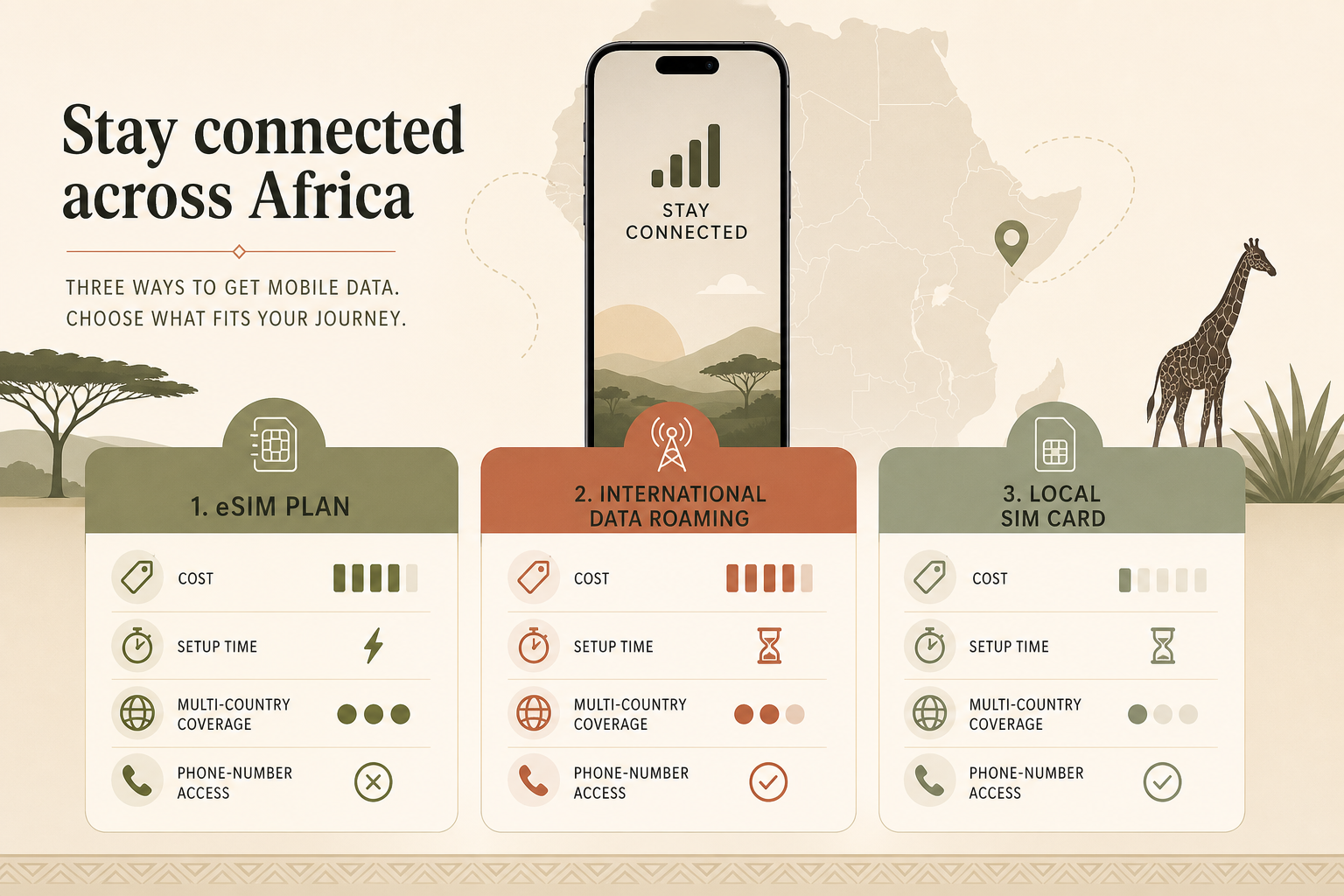
Compare cost, setup, coverage, and phone-number access before choosing mobile data for an Africa trip.