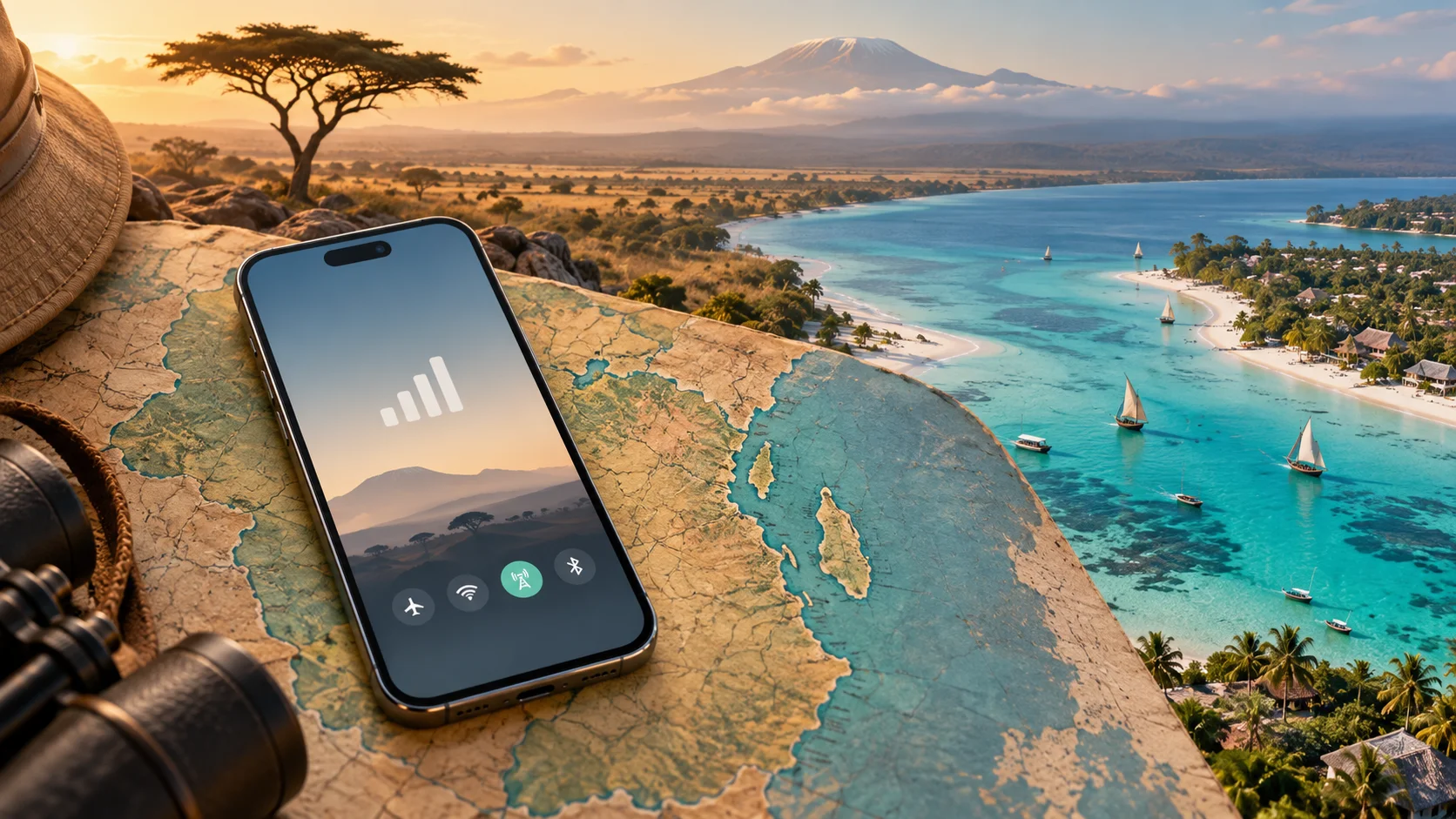
An eSIM for Tanzania gives you data the moment you land, with plans typically running from 1GB for short trips up to 20GB or unlimited options for 30 days. Vodacom and Airtel dominate coverage in Dar es Salaam, Arusha and Zanzibar, while the northern safari circuit presents a patchwork: signal appears near lodge zones and park gates, then drops as you move into open country.
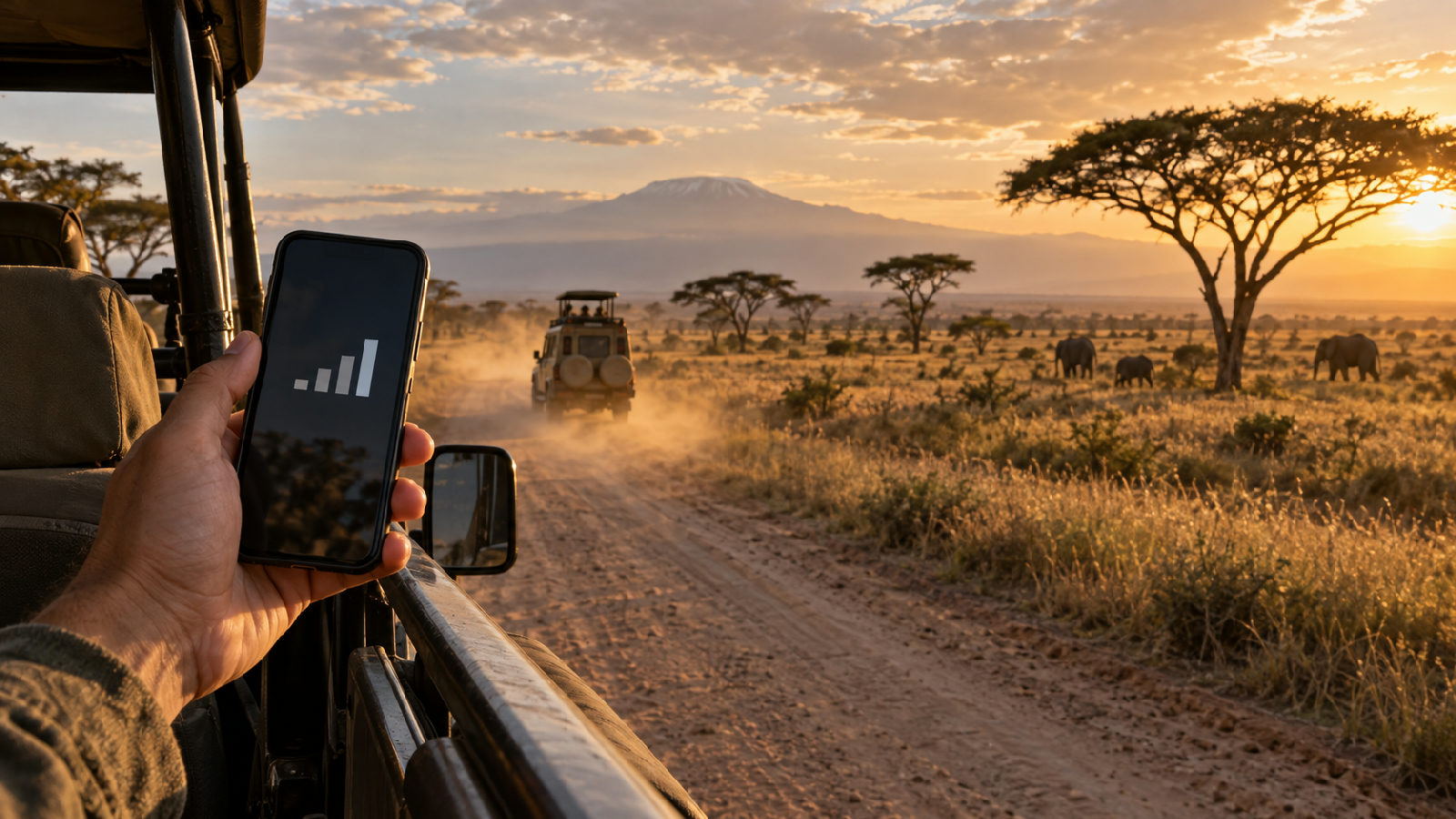
An eSIM helps travellers get connected from arrival through Tanzania’s cities, islands and safari routes.
Trip type | Data option | Validity |
|---|---|---|
Short trips | From 1 GB | Not specified |
Longer stays | Up to 20 GB or unlimited | 30 days |
Tanzania eSIM plans range from small short-trip packages to 30-day high-data and unlimited options.
Tanzania's internet penetration passed 50% in 2024, but rural areas still lean on 2G and 3G rather than 4G. Central Serengeti around Seronera connects better than remote spots like Ndutu and Lake Natron, where every network struggles. On Kilimanjaro, signal cuts out above 3,000 m. The result is connectivity that comes and goes rather than vanishing completely—frustrating when your phone burns battery trying to push a photo on one bar.
This guide covers which eSIM plans work best for Tanzania in 2026, what they cost, and where you can expect coverage to hold or fade across the mainland and islands.
Quick answer: Which eSIM is best for Tanzania in 2026?
For most travellers, a 30-day plan with at least 10 GB provides enough data to stay connected across Tanzania's cities and national parks without constant top-ups. Vodacom consistently delivers the widest coverage, including parts of the central Serengeti near Seronera where other networks fade. Plans from providers like Airalo and Nomad start around $15–$20 for 10 GB valid for 30 days, while unlimited options hover closer to $40–$50.
If your trip focuses on the northern circuit—Tarangire, Lake Manyara, Ngorongoro—a mid-range plan performs well because those parks sit closer to towns. For deeper Serengeti zones, Ndutu, or Lake Natron, even the best eSIM for Tanzania will face stretches with no signal. In those areas, the goal shifts from unlimited streaming to efficient messaging: WhatsApp and email work on intermittent 3G, but uploading photos requires patience or a return to lodges with Wi-Fi.
2026 Tanzania eSIM plans and prices compared by data, validity and network
Most travelers arriving in Tanzania in 2026 choose between plans that run 7, 15 or 30 days. A week-long safari typically needs 3–5 GB if you're uploading photos each evening at the lodge. Two-week itineraries that add Zanzibar or a Kilimanjaro trek sit better with 10 GB or an unlimited Tanzania eSIM that throttles after a threshold rather than cutting you off.
Vodacom remains the most widely deployed network across national parks, though Airtel and Tigo have improved rural reach since 2024. When comparing plans, check which local operator the eSIM uses—some resellers route through Vodacom, others through Airtel. A 30-day plan with 20 GB on Vodacom typically costs $28–$42, while shorter validity windows drop the price but raise the per-gigabyte rate. Unlimited data plans for Tanzania often cap speeds at 2 Mbps after 10–15 GB, which is enough for messaging and map loading but will stall video uploads until you reach faster coverage near Arusha or Dar es Salaam.
eSIM coverage in Dar es Salaam, Zanzibar and other populated areas
Urban Tanzania delivers the data experience visitors expect in 2026. Dar es Salaam, Arusha, Moshi and Stone Town all offer stable 4G through Vodacom, Airtel and Tigo, with 5G spreading across the commercial districts of Dar. An eSIM for Tanzania will connect within seconds of arrival at Julius Nyerere International, and most 30 days plans provide more than enough data for navigation, messaging and cloud backup across the city.
Zanzibar's coverage extends reliably along the coast from Nungwi to Paje, and inland to Jozani Forest. The archipelago benefits from its compact geography and steady visitor numbers, which have kept network investment consistent. Signal drops briefly between villages on the east coast road, but rarely for more than a few minutes.
The pattern changes sharply outside town limits. Once the vehicle turns toward Tarangire or the Ngorongoro highlands, 4G becomes intermittent, then absent. Central Serengeti around Seronera maintains the best connectivity inside any national park, but even there it is in-and-out rather than continuous. Ndutu and Lake Natron remain offline across all carriers.
Safari connectivity: Serengeti, Ngorongoro, Tarangire, Lake Manyara and Lake Natron
Signal in Tanzania's safari parks follows a predictable rhythm. Coverage appears near lodge clusters, park gates and ranger stations, then drops as you head into open bush. Central Serengeti around Seronera offers the most reliable connectivity of any major wilderness area, while Ndutu and Lake Natron regularly deliver zero bars across all networks.
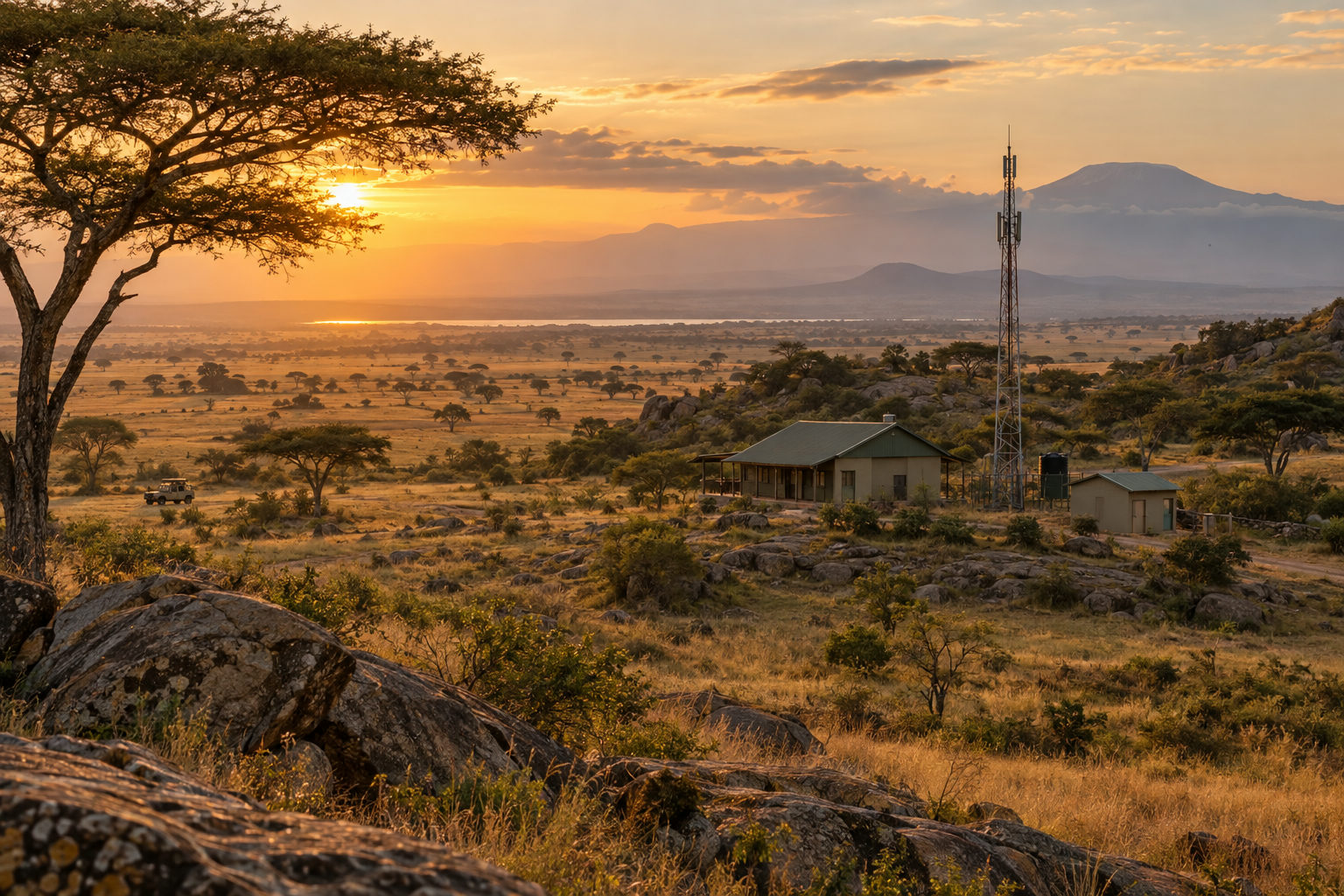
Safari connectivity is generally strongest near lodge clusters, park gates and ranger stations.
Lake Manyara and Tarangire perform better than the Serengeti because they sit closer to towns with existing tower infrastructure. The floor of Ngorongoro Crater presents the hardest connectivity challenge—deep topography blocks signal entirely in some sections. On Kilimanjaro, coverage stops above 3,000 m, a useful reference point for understanding how altitude affects mobile networks across Tanzania's higher terrain.
The frustration isn't total absence. One bar of 2G or 3G will keep your phone trying to sync photos and drain your battery in the process. A Tanzania eSIM with a 30-day plan and sufficient data lets you download maps and messages during brief windows of coverage, then go offline without losing functionality. Vodacom typically edges out competitors in rural reach, but no network claims consistent service deep in the parks.
Kilimanjaro coverage and why altitude, terrain and distance affect signal
On Kilimanjaro, mobile signal stops at around 3,000 metres. Above that line, no Tanzania eSIM will connect, regardless of which plan or network you're using. The cutoff is reliable enough that trekkers treat it as a known milestone: last chance to send a message is usually somewhere between Horombo Hut and Kibo Hut, depending on the route.
The pattern holds across Tanzania's other high-altitude zones. Terrain blocks line-of-sight to towers, and the further you move from settlements, the thinner coverage becomes. Vodacom has the best reach into remote areas in 2026, but even the strongest network can't solve for distance and topography. If you need data during a multi-day trek or a drive through the western circuit, plan around intermittent access rather than assuming continuous connectivity.
Tanzania eSIM vs local Vodacom or Airtel SIM card
A local SIM from Vodacom or Airtel costs between $5 and $15 at the airport, plus the time spent queuing and registering with passport details. Coverage on both networks mirrors what most Tanzania eSIM providers deliver, because those eSIM plans rent capacity from the same towers. Vodacom runs the largest network in Tanzania, reaching into more rural areas than Airtel, but neither escapes the in-and-out signal pattern described across safari circuits.
The best reason to choose an eSIM in 2026 is activation before you land. You step off the plane with data already working, no queue, no forms, no fumbling with a SIM tool in the arrivals hall. A 30 days unlimited plan purchased as an eSIM typically costs $20 to $35, comparable to what you would spend topping up a local SIM across the same period. For trips under two weeks, an eSIM for Tanzania with 10GB or 20GB validity gives you enough data without the airport detour.
How to check compatibility, install your eSIM and activate it on arrival
Most phones sold after 2018 support eSIM, but not all. On iPhone, go to Settings → General → About and look for a Digital SIM or eSIM line. If you see IMEI and EID listed, your device works. Android varies by manufacturer—Samsung Galaxy S20 and newer, Google Pixel 3 and later, and recent Oppo and Motorola flagships are usually compatible. Huawei devices typically are not, even recent ones.
Once you buy a Tanzania eSIM plan, you receive a QR code by email. Install it before departure by scanning the code under your phone's mobile network or cellular settings. The eSIM sits dormant until you land. On arrival, enable data roaming and select the new eSIM as your active data line. Most Vodacom-backed plans connect within two minutes of switching on.
If you are travelling between Tanzania and neighbouring countries, check whether your plan covers multiple destinations or if you need separate data for each border crossing.
How to manage weak signals, battery drain, offline maps and emergency communication
The in-and-out signal pattern across Tanzania's safari circuit is more frustrating than none at all. A phone showing one bar will still attempt to sync photos, check email and push notifications, draining your battery in the process. The best approach in 2026 is to enable airplane mode between towns and lodges, then manually turn on data when you reach areas with known coverage.
Download offline maps before you leave Arusha or Dar es Salaam. Google Maps, Maps.me and OsmAnd all support Tanzania's road network and park boundaries. A 30-day Tanzania eSIM with 10 GB or 20 GB gives you enough data to download multiple regions without worrying about running out during the trip.
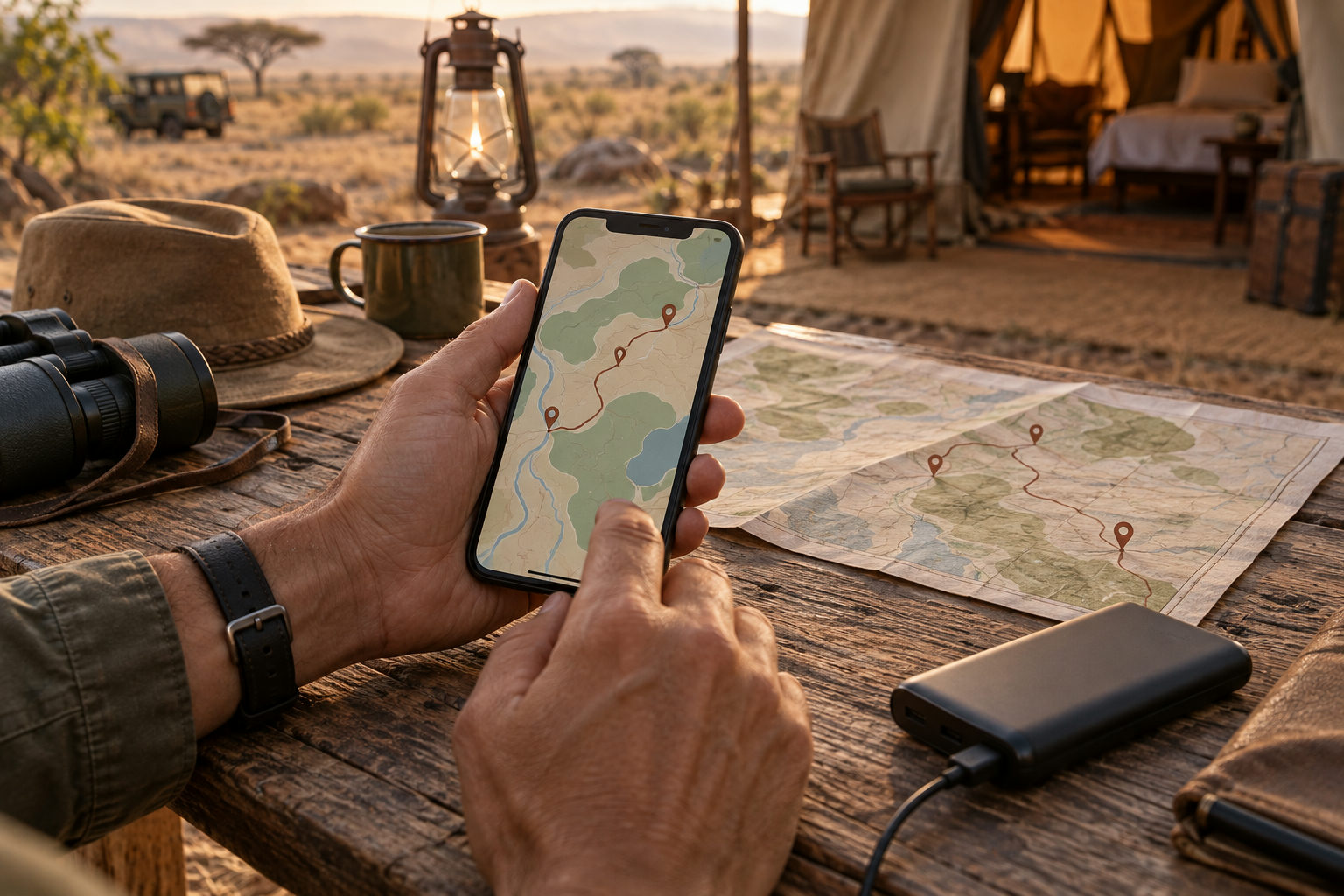
Download offline maps before leaving major towns, where safari-area signal can be unreliable.
Carry a portable battery pack rated for at least two full phone charges. If you're climbing Kilimanjaro or heading to Lake Natron, assume zero connectivity and plan communication windows accordingly. Lodge Wi-Fi, when available, is slow but sufficient for messaging apps and weather checks.
East Africa travel: Tanzania and Kenya eSIM options, regional plans and Kenya data packages
Tanzania and Kenya share a border, an ecosystem and a safari circuit that pulls travellers across both countries in a single trip. The Maasai Mara connects directly to the Serengeti, and many itineraries thread Amboseli, Tsavo or the Kenyan coast into a longer East Africa loop. That movement creates a practical question: do you buy separate eSIMs for each country, or does a regional plan make more sense?
Regional eSIM plans bundle Tanzania, Kenya, Uganda, Rwanda and sometimes Ethiopia into a single data package. They cost more per gigabyte than a country-specific Tanzania eSIM, but they remove the need to switch profiles or buy a second plan mid-trip. A 3 GB regional plan valid for 30 days typically costs between $18 and $28 in 2026, depending on the provider. Single-country Tanzania plans with the same validity offer 5 GB to 10 GB for less, so the trade-off is volume versus convenience.
If your route crosses into Kenya for more than a day or two, a regional plan is usually the best option. For Tanzania-only safaris with a brief Nairobi stopover, stick with a dedicated Tanzania eSIM and rely on airport or hotel Wi-Fi in Kenya.
Disadvantages of eSIMs, fair-use limits, hotspot rules and VPN legality in Tanzania
eSIMs work well in Tanzania, but they come with limitations worth knowing before you land. Device compatibility is the first barrier: older phones and budget Android models often lack eSIM support, and if your phone is carrier-locked, the eSIM won't activate regardless of model year. Unlike a physical SIM you can move between devices, an eSIM stays tied to one phone unless you delete and reinstall it, which some providers count as a new activation.
Fair-use policies are common across Tanzania eSIM plans marketed as unlimited. Speeds may drop to 2G after you pass 1 GB per day or 10 GB over 30 days, depending on the provider. Hotspot and tethering are usually allowed but not always explicitly stated, so confirm before relying on your phone to share data with a laptop or tablet.
VPN use is legal in Tanzania in 2026, though speeds on Vodacom and Airtel networks can be slow even without encryption. If you're working remotely or accessing banking apps, test your VPN connection in Dar es Salaam or Arusha before heading into the parks, where weak signal will make any VPN unreliable.
Frequently asked questions about Tanzania eSIMs, mobile data, Tanzania time and travel
Do I need an unlimited data plan for a Tanzania safari?
No. Most travellers use between 2 GB and 5 GB across a two-week trip when they keep photos for upload until they reach Wi-Fi and use offline maps. Signal appears near lodges and gates, then drops as vehicles move into open country, so the phone spends less time connected than you expect. A 10 GB plan with 30 days validity covers most itineraries without paying for capacity you will not use in areas where there is no signal to begin with.
Which network has the best coverage in the Serengeti?
Vodacom holds the strongest position across the northern circuit. Central Serengeti around Seronera is the best connected part of the park. Coverage thins in the western corridor and disappears almost completely in Ndutu and near Lake Natron. Both Vodacom and Airtel rely on 2G and 3G in remote areas, so expect slower speeds outside Dar es Salaam, Arusha and Zanzibar even when signal is present.
Can I use the same eSIM for Tanzania and Kenya?
Yes, if you choose a regional East Africa plan. Single-country Tanzania eSIMs do not cover Kenya, so a Safari eSIM with multi-country support is the simpler option when your itinerary crosses the border. Regional plans typically cost more per gigabyte than single-country options, so compare the price difference against the convenience of one activation for both countries.
What is Tanzania time in 2026?
Tanzania operates on East Africa Time (EAT), which is UTC+3 year-round. There is no daylight saving adjustment.