
Safaricom vs Airtel Kenya comes down to coverage and price. Safaricom dominates with nationwide 4G across cities, safari parks and rural areas, while Airtel offers cheaper data bundles but weaker rural signals. For travellers, Safaricom eSIM provides reliable connectivity in remote locations where Airtel often drops out.
A smartphone and SIM card represent mobile connectivity for travel in Kenya. — Photo: makeitkenya / Openverse (CC PDM)
Airtel vs Safaricom Kenya comes down to coverage and price.
Safaricom dominates with nationwide 4G across cities, safari parks and rural areas, while Airtel offers cheaper data bundles but weaker rural signals.
For travellers, Safaricom eSIM provides reliable connectivity in remote locations where Airtel often drops out.
Safaricom holds roughly 65% of Kenya's mobile market, with base stations in all 47 counties including Maasai Mara, Amboseli and Tsavo.
Airtel covers urban centres well but struggles in national parks and along highways between major towns.
One practical point settles it for short-stay visitors: Airtel still has no commercial eSIM in Kenya, so a line that is live the moment you land has to be Safaricom.
The trade-off is price. Airtel undercuts Safaricom's bundles by roughly 10–20%, which suits anyone whose trip stays inside Nairobi, Mombasa or Kisumu. Pay the Safaricom premium and what you get back is signal on upcountry roads and in the parks, plus M-PESA, which is still the payment method most shops, lodges and drivers expect.
This guide compares network reach, data plan pricing, tourist packages and real-world performance across Kenya's cities, highways and wilderness areas. We cover prepaid options, postpaid contracts, and eSIM availability for both networks.
Which network should you choose in Kenya?
Choose Safaricom if you need the widest coverage, dependable service outside major towns or access to M-Pesa, especially when travelling to rural areas and safari destinations. Choose Airtel if you mainly use your phone in Nairobi, Mombasa or other urban centres and want a competitive alternative for everyday calls and data. For many visitors, Safaricom is the safer all-round choice.
Which is the best mobile network in Kenya?
Safaricom remains the best mobile network in Kenya for most users in 2026. The operator covers 96% of the population and delivers the strongest performance for digital services in rural areas, national parks and along major transport corridors. If you're travelling beyond Nairobi or Mombasa, Safaricom's infrastructure advantage becomes clear—4G service reaches remote lodges and conservancies where Airtel often drops to 3G or loses signal entirely.
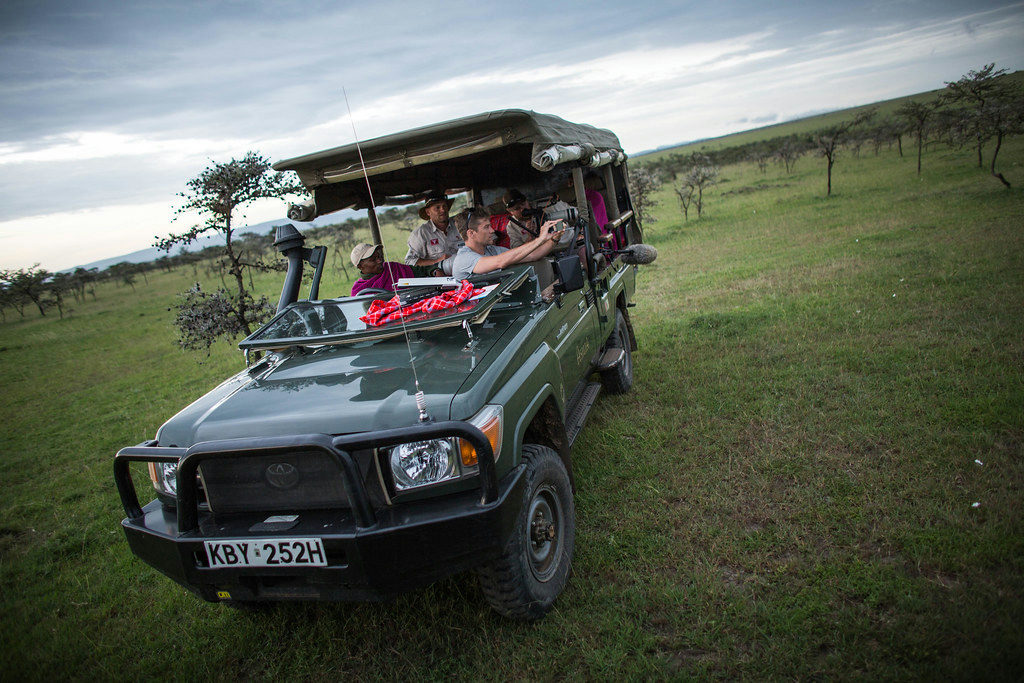
Staying connected on safari in Kenya — Photo: makeitkenya / Openverse (CC PDM)
Airtel works well in urban centres and costs less for basic plans, but it struggles in less populated regions. Business travellers relying on connectivity services and digital nomads typically prefer Safaricom for its reliable speeds and widespread reach. Tourists heading to safari destinations should choose eSIM Kenya options with Safaricom connectivity to avoid connection gaps in parks like Maasai Mara, Amboseli or Tsavo. The operator's investment in rural tower infrastructure means you'll maintain signal where competitors often fail, which matters when you need navigation, booking confirmations or emergency contact during your trip.
As of 2026, Safaricom dominates the mobile sector with approximately 65% subscriber share, maintaining steady growth and operating the most extensive 4G infrastructure—covering over 95% of the population. Airtel Kenya holds roughly 25% subscriber share and offers competitive pricing, particularly on bundles, though its 4G footprint is smaller—concentrated in Nairobi, Mombasa, Kisumu and other urban centres. In remote safari regions and national parks, the incumbent operator's infrastructure typically outperforms its competitor, making it the preferred choice for travellers visiting the Maasai Mara, Amboseli or Tsavo.
Metric | Safaricom | Airtel |
|---|---|---|
Subscriber share | Approximately 65% | Approximately 35% |
4G population coverage | Approximately 95% | Approximately 30% |
Active base stations | Around 700 | Roughly 400 |
Safaricom’s larger subscriber base is matched by broader 4G coverage and more active base stations.
Safaricom's prepaid bundles start from KES 20 for 50 MB daily data, with weekly tourist packages around KES 500–1,500 depending on data allowance. Airtel often undercuts these rates by 10–20%, but the trade-off is reduced rural coverage. Both networks support eSIM activation, though Safaricom's eSIM service is more widely available and simpler to set up for international visitors. For voice calls, Safaricom charges approximately KES 3 per minute on-net, while Airtel's rates sit closer to KES 2.50, making it slightly cheaper for local calls within its network.
How do coverage and signal compare in Nairobi and rural Kenya?
Safaricom maintains the strongest network footprint across Kenya, covering approximately 96% of the population with 4G and reaching remote areas that other operators cannot match. In Nairobi and major urban centres, both Safaricom and Airtel deliver reliable signal strength for calls, messaging and data. The difference becomes pronounced once you leave tarmac roads: Safaricom's infrastructure extends to tourist circuits including the Maasai Mara, Amboseli, Tsavo and coastal regions, while Airtel's rural reach remains limited to main highways and larger towns.
Signal performance in national parks and conservancies favours Safaricom, particularly for visitors who need connectivity during game drives or at remote lodges. Airtel has invested in expanding its 4G footprint in recent years, but coverage gaps persist in areas like northern Kenya, western highlands and sections of the Great Rift Valley. If your travel plans include safari destinations or off-grid locations, a Safaricom eSIM offers the most dependable mobile access. For trips confined to Nairobi, Mombasa or Kisumu, Airtel provides adequate coverage at competitive rates.
Which network delivers faster and more reliable 4G and 5G data?
Safaricom operates Kenya's most extensive 4G network, covering approximately 95% of the population, and rolled out 5G service in 2021 across major urban areas including Nairobi, Kisumu, Kisii, Kakamega and Mombasa. The network typically delivers download speeds between 15–40 Mbps on 4G in built-up areas, with 5G reaching 400+ Mbps where available. Airtel's 4G footprint is smaller but improving, with solid performance in Nairobi and other Kenyan cities but noticeably weaker rural penetration. Airtel launched limited 5G trials in late 2022 but commercial availability remains sparse.
Which network is better than Airtel?
Safaricom consistently outperforms Airtel on speed, latency and reliability, particularly outside major towns. Independent testing shows Safaricom delivers lower packet loss and more stable connections during peak hours. If your itinerary includes national parks, coastal regions or upcountry routes, eSIM Kenya data on Safaricom's network will keep you connected where Airtel frequently drops to 3G or loses service entirely. For visitors prioritising dependable internet, Safaricom is the clear winner.
Which offers better-value data bundles, calls and roaming?
Safaricom's data bundles start at KES 20 for 15 MB (24 hours) and scale to KES 2,000 for 20 GB (30 days), while Airtel typically undercuts those rates by 10–15%. Airtel's 1 GB weekly bundle costs KES 100 compared to Safaricom's KES 120, and its 6 GB monthly plan sits at KES 500 versus Safaricom's KES 700 for the same volume. For calls, both networks charge around KES 2 per minute on-net and KES 4 off-net, though Airtel frequently runs promotions that drop per-minute rates below KES 1 during evenings and weekends. Visitors who prefer prepaid flexibility will find Airtel's tariffs easier on the budget, but eSIM options from Safaricom deliver strong value for data-heavy users who need consistent access across national parks and remote regions.
Provider | Starting Price | Data Allowance | Validity |
|---|---|---|---|
Safaricom | KES 20 | 15 MB | 24 hours |
Safaricom | KES 2,000 | 20 GB | 30 days |
Airtel | 10–15% cheaper than Safaricom rates | Comparable tiers | Similar validity periods |
Safaricom and Airtel data bundle pricing comparison.
Network | Starting bundle | Larger bundle |
|---|---|---|
Safaricom | KES 20 for 15 MB (24 hours) | KES 2,000 for 20 GB (30 days) |
Airtel | Typically undercuts Safaricom rates by 10–15% | |
Data-bundle pricing cited in the comparison section.
Network | Starting bundle | Larger bundle | Typical price position |
|---|---|---|---|
Safaricom | KES 20 for 15 MB, valid for 24 hours | KES 2,000 for 20 GB, valid for 30 days | — |
Airtel | — | — | Typically 10–15% cheaper than Safaricom |
Data-bundle examples and relative pricing stated in the comparison section.
Roaming is where Safaricom pulls ahead. Its bilateral agreements cover more than 230 networks in over 170 countries, and roaming data rates in neighbouring Tanzania and Uganda hover around KES 10 per MB with bundle discounts. Airtel's roaming footprint is narrower, and per-MB charges can reach KES 15–20 without a dedicated roaming pack. For travellers moving between Kenya and other East African countries, Safaricom's better roaming terms and wider partner network offset its slightly higher domestic bundle costs.
Is Airtel Money cheaper than Safaricom M-PESA?
Both mobile money platforms charge similar rates for most transactions, though Airtel Money typically edges ahead on cost for certain transfers and withdrawals. Sending money to another user costs the same on both networks—free for person-to-person transfers within the same network—but Airtel Money charges slightly lower fees when withdrawing cash at agents, particularly for amounts above KES 2,500. M-PESA's advantage lies in its far wider agent network, meaning you'll rarely struggle to access your funds even in remote areas.
Is Safaricom bigger than Airtel?
Yes, Safaricom dominates Kenya's mobile market with over 42 million subscribers compared to Airtel's roughly 18 million. That scale translates to better infrastructure: Safaricom operates more than 6,000 base stations nationwide, while Airtel runs around 2,500. The gap shows most clearly in M-PESA's merchant acceptance—more than 500,000 businesses take M-PESA payments, compared to fewer than 100,000 for Airtel Money. If you're visiting Kenya and need reliable connectivity across parks and rural regions, a Safaricom eSIM offers the infrastructure and coverage that comes with being the market leader.
Can you use eSIM with Safaricom and Airtel in Kenya?
Safaricom launched eSIM support in 2020 and now offers the widest eSIM infrastructure in Kenya, covering both local subscribers and tourists. You can buy a Safaricom eSIM online before arrival or activate one at retail outlets in Nairobi, Mombasa and other major towns. Compatible devices include iPhone XS and later, recent Samsung Galaxy models, and Google Pixel 3 and above. Registration requires a passport and Kenyan address; the QR code arrives by email within minutes for tourist plans.
Airtel Kenya announced eSIM trials in late 2023 but has not yet rolled out commercial eSIM services to the public. The network continues to invest in 4G and 5G growth but has prioritised SIM card distribution through its retail footprint. For now, travellers and locals relying on eSIM technology will need to choose Safaricom or international eSIM providers that connect through local carrier agreements. Airtel's physical SIM cards remain widely available at airports, supermarkets and branded shops across Kenya.
How to buy and activate a Safaricom or Airtel SIM and eSIM
Both networks sell physical SIM cards at airports, official shops, supermarkets and authorised dealers across Kenya. Registration is mandatory: bring your passport and expect the process to take 5–15 minutes. Safaricom outlets are more common in shopping centres and petrol stations; Airtel has fewer physical locations but still maintains a national network of agents. Top-up is straightforward through M-PESA, Airtel Money, scratch cards or mobile banking.
For eSIM in Kenya, Safaricom supports it on compatible devices (iPhone XS and later, recent Samsung Galaxy models) through the MySafaricom app or selected shops with eSIM provisioning. Airtel's eSIM rollout is slower and less widely available; many tourists find it simpler to order a Safaricom eSIM online before arrival. Activation typically completes within minutes once you scan the QR code and select the eSIM as your data line. If you share your connection via hotspot, both networks allow tethering on standard prepaid plans without extra charges.
What do customer experiences and Reddit reports reveal about Safaricom eSIM?
Reddit threads and online forums show that Safaricom eSIM works reliably for most tourists and business travellers once activated, though setup frustrations remain common. Users report delays of several hours between purchase and profile delivery, particularly when buying through third-party resellers rather than Safaricom's own channels. QR codes occasionally fail to scan on first attempt, requiring manual entry of activation codes or contact with support.
Coverage praise dominates customer feedback. Travellers consistently note strong 4G signal in national parks including Maasai Mara, Amboseli and Tsavo, where competing networks drop to Edge or lose service entirely. Reddit users confirm that Safaricom's 35 million customer base supports wider rural infrastructure than Airtel's 20 million, translating to better connectivity outside Nairobi and Mombasa. Speed complaints centre on throttling after bundle exhaustion rather than network capacity, with multiple reports of sub-512 kbps rates once prepaid data runs out. Data top-ups resolve the issue immediately, but customers note the lack of warning before throttling begins.
Best options for tourists, residents, remote workers and dual-SIM users
Tourists staying under three weeks should prioritise convenience and coverage. A Safaricom eSIM activates before arrival, includes 5GB to 50GB bundles priced from KES 500 to KES 3,000, and delivers signal in national parks and remote safari routes where Airtel often drops out. Day visitors to Nairobi or Mombasa can use either network without penalty, but anyone heading to Maasai Mara, Amboseli or Samburu will find Safaricom's rural footprint essential.
Residents and long-term remote workers benefit from dual-SIM setups: keep Safaricom as the primary line for M-PESA and reliable data, then add Airtel for cheaper voice calls and promotional bundles. Remote workers streaming video calls need Safaricom's wider 4G reach in residential estates and co-working hubs outside central business districts. Expats who travel frequently across East Africa should check Airtel's roaming rates in Uganda and Tanzania, which undercut Safaricom by 30 to 40 per cent on some routes, making it the better second SIM for cross-border business or leisure travel.
FAQs: Is Safaricom bigger, who owns Airtel, and what are the alternatives?
Safaricom remains Kenya's largest mobile operator by subscriber count and revenue, holding roughly 64% of the market as of 2026. The company is publicly traded on the Nairobi Securities Exchange, with the Kenyan government retaining a 35% stake and Vodafone holding 34.9%. Airtel Kenya is a wholly owned subsidiary of Airtel Africa, which in turn is part of India's Bharti Airtel group. Bharti's presence across 14 African countries gives Airtel Kenya access to continent-wide infrastructure and roaming agreements, though its Kenyan market share sits at around 22%.
For visitors prioritising immediate connectivity, a Safaricom eSIM can be activated before arrival and delivers the widest coverage from Nairobi to rural parks. Residents seeking lower data rates or secondary lines often pair Safaricom with an Airtel SIM to exploit each network's promotional bundles. Telkom Kenya, the third national operator, covers urban centres and offers competitive plans but lacks the rural footprint required for safari or upcountry travel. Most users find that a Safaricom primary line with an Airtel backup provides the best balance of reliability, cost and national reach for everyday use and remote work.
Which network works best in Kenya's national parks?
Safaricom's 4G reaches the Maasai Mara, Amboseli and most of the Rift Valley. Airtel coverage thins outside major towns, so serious safari-goers carry a Safaricom data line.
Can I keep both Safaricom and Airtel numbers active?
Yes. Dual-SIM phones let you run Safaricom for data and Airtel for cheaper off-net calls, or maintain separate work and personal lines without swapping cards.