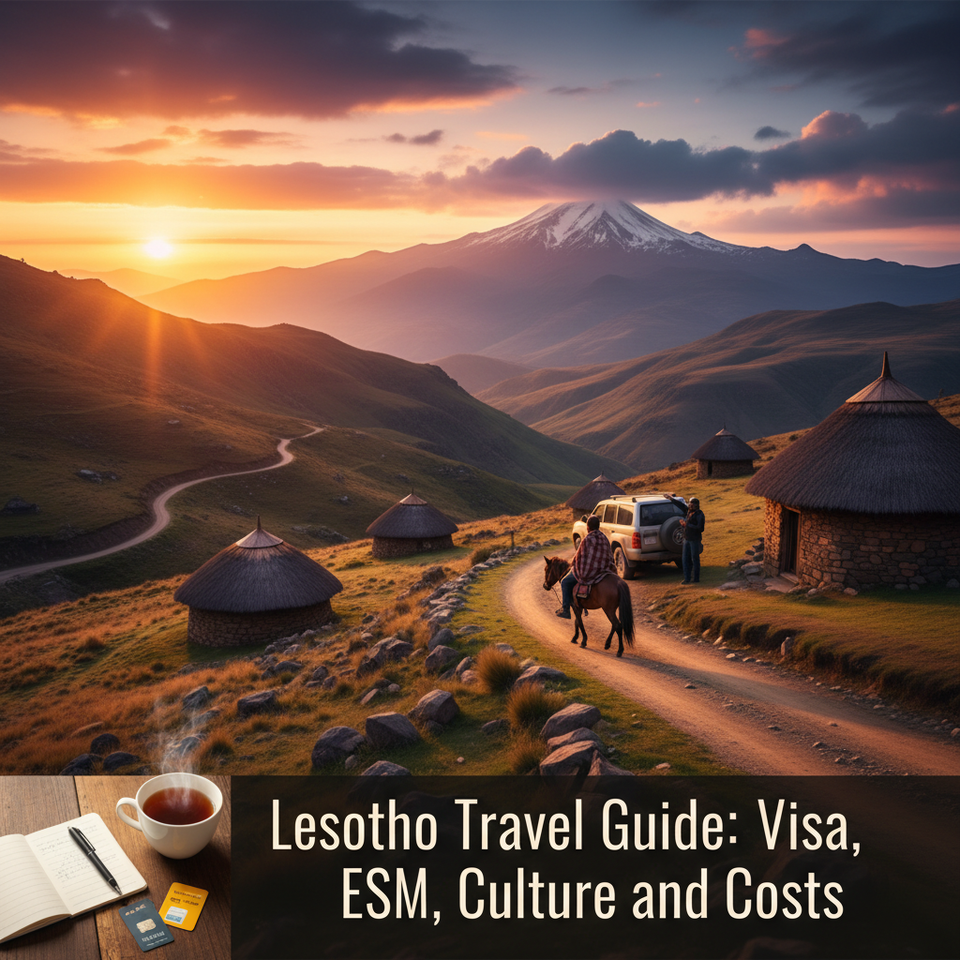
This Lesotho travel guide covers everything you need to plan a trip to the Mountain Kingdom: visa policies for most nationalities, staying connected with an eSIM, understanding local customs including traditional Basotho blankets, and budgeting for accommodation, transport, and meals across different travel styles.
Lesotho sits entirely above 1,400 meters, making it the highest country in the world by minimum elevation.
Most visitors arrive through South Africa, crossing at Maseru Bridge or one of the mountain passes.
English and Sesotho are both official languages, and you'll hear Sesotho spoken widely in villages and markets.
The Basotho blanket—a thick wool wrap with geometric patterns—remains everyday attire in rural areas and during ceremonies, not just a souvenir.
Citizens of most Western countries enter visa-free for up to 14 days, while others can apply on arrival.
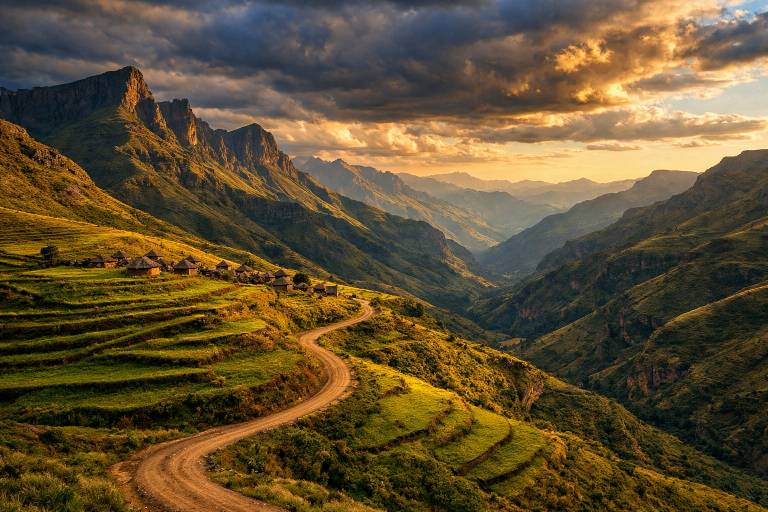
Lesotho's rugged highlands make it the highest country in the world by minimum elevation.
Lesotho sits entirely above 1,400 meters, making it the highest country in the world by minimum elevation. Most visitors arrive through South Africa, crossing at Maseru Bridge or one of the mountain passes. English and Sesotho are both official languages, and you'll hear Sesotho spoken widely in villages and markets. The Basotho blanket—a thick wool wrap with geometric patterns—remains everyday attire in rural areas and during ceremonies, not just a souvenir.
Citizens of most Western countries enter visa-free for up to 14 days, while others can apply on arrival. An eSIM lets you stay online from the moment you land without hunting for a SIM card shop in Maseru. Daily costs range from budget guesthouse stays around $15–25 to mid-range lodges at $60–100, with minibus taxis covering short routes for under $2 and 4x4 hires starting near $50 per day.
How should you plan a trip to Lesotho?
Start with the season and route, since both affect road access and your choice of transport. Then confirm entry requirements, set a daily budget, arrange connectivity, and review local language, etiquette, payments, electricity, and packing before departure.
Is Lesotho worth visiting? A quick trip-planning snapshot
Lesotho stands apart from the typical African safari circuit. This mountainous kingdom delivers dramatic highland scenery, strong cultural traditions, and genuine remoteness without requiring malaria prophylaxis or navigating crowded tourist infrastructure. You'll meet Basotho herders wearing colorful blankets and the distinctive mokorotlo straw hat, ride Basotho ponies through river valleys, and sleep in villages where Sesotho is the primary language and English serves as the official second tongue. The country operates on a visa-on-arrival system for most Western passport holders, and an eSIM keeps you connected across the highlands without hunting for a local SIM card at the border.
Can Americans go to Lesotho?
Yes. US citizens receive a free 14-day visa on arrival at any port of entry, extendable to 90 days through the Ministry of Home Affairs in Maseru. You need six months of passport validity and proof of onward travel. Budget around $40–70 per day for modest guesthouse accommodation and meals, more if you're booking guided pony treks or staying in lodges. The South African rand circulates alongside the local loti at a 1:1 rate, simplifying cash management if you're combining Lesotho with a South African itinerary.
When is the best time to visit Lesotho? Weather and seasons
Lesotho sits entirely above 1,400 meters, which means the weather swings hard between seasons. Summer runs from November through March, bringing afternoon thunderstorms and temperatures that climb to 30°C in the lowlands but stay cooler in the highlands. Roads turn slick after rain, and some mountain passes close temporarily, but the landscape is green and waterfalls run at full force. Winter spans May to August, dropping temperatures well below freezing at night in the highlands—some areas see snow from June through August, and Afriski Mountain Resort opens for skiing. Days are clear and dry, perfect for trekking, though you'll need serious cold-weather gear above 2,000 meters.
Spring and autumn offer the most stable conditions. September through October and April bring mild days, fewer crowds, and roads that stay passable. If you're planning a pony trek through the mountains or a multi-day hike, aim for these shoulder months. Winter works if you want snow sports or dramatic highland scenery, but summer is the only time to catch the seasonal waterfalls in full flow. Pack layers regardless of when you visit—altitude shifts fast, and mornings start cold even in summer.
Where should you go? Top places and sample Lesotho itineraries
Maseru, the capital, is your entry point and base for exploring craft markets and cultural museums. From there, most visitors head east into the highlands. Thaba-Bosiu, a flat-topped mountain 24 km outside Maseru, is where King Moshoeshoe I founded the nation in 1824—it's a half-day trip that sets the historical context for everything else. The Maluti Mountains run the length of the country and hold most of the trekking routes: Ts'ehlanyane National Park in the north offers multi-day hikes through alpine terrain, while Sehlabathebe National Park in the southeast sits at 2,400 m and feels genuinely remote. Sani Pass, the steep gravel road linking Lesotho to South Africa's Drakensberg, is usually tackled as a day trip from Underberg or as part of a loop through the eastern highlands.
A typical five-day itinerary might look like this: day one in Maseru for orientation and supplies, day two at Thaba-Bosiu and on to Malealea for pony trekking, days three and four hiking in Ts'ehlanyane or around Mokhotlong, and day five returning via Sani Pass. Seven days lets you add Sehlabathebe or a village homestay. You'll need a 4x4 for most routes outside Maseru, and road conditions change with the season—gravel turns to mud in summer rains.
Do US travelers need a visa for Lesotho? Entry requirements and border crossings
US citizens can enter Lesotho visa-free for up to 14 days. You'll need a passport valid for at least six months beyond your departure date, a return or onward ticket, and proof of sufficient funds. Immigration officers typically grant the initial two-week stay at the border, and you can extend it by visiting the Ministry of Home Affairs in Maseru if you want to stay longer. Most travelers enter overland from South Africa through one of the main crossings—Maseru Bridge, Sani Pass, or Caledonspoort—though Moshoeshoe I International Airport near Maseru handles a handful of regional flights each week.
You won't need vaccinations unless you're arriving from a yellow fever endemic country, but travel insurance is strongly recommended for any medical emergencies or evacuation from remote highland areas. Staying connected is straightforward: buy a local SIM on arrival or set up an eSIM before you leave. Data plans run about $5 to $10 for a few gigabytes, and coverage is reliable in towns and along main routes, though it thins out in the high mountains. South African rand is accepted everywhere alongside the loti, and most lodges and restaurants in Maseru take cards, but carry cash for rural guesthouses and craft markets.
Is Lesotho Safe, and How Does It Compare with South Africa?
Lesotho is generally safe for travelers who take standard precautions, though petty crime like pickpocketing occurs in Maseru and larger towns. Violent crime against tourists is uncommon, particularly in rural highland areas where communities are tight-knit and visitors are welcomed. The country's crime rate is lower than South Africa's urban centers, but you should still avoid displaying valuables, stick to well-traveled routes after dark, and hire a reputable guide for remote hiking trips. Road conditions pose a bigger practical risk than crime—mountain passes are steep, often unpaved, and require a 4x4 with an experienced driver.
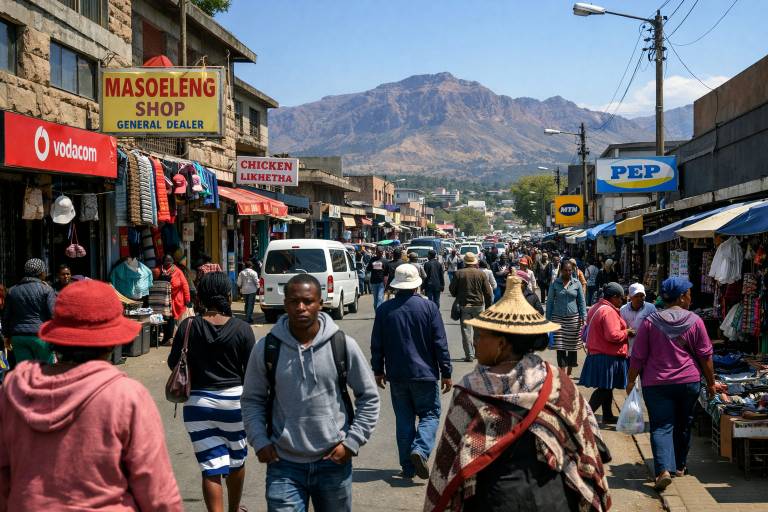
Maseru's streets are generally safe during the day, though travelers should stay alert in crowded areas.
Is it safe to travel to Lesotho right now?
Yes, Lesotho remains open and safe for travel in 2026. The country has no active travel warnings from the US State Department beyond standard advice to exercise normal caution. Political demonstrations occasionally occur in Maseru but rarely affect tourists, and the highlands where most visitors spend their time are peaceful. Cell coverage is reliable in towns and along main routes, so staying connected with an eSIM means you can reach help or navigate back if plans change unexpectedly.
Comparing crime risks and travel infrastructure
These practical details cover using cash and cards, tipping for common services, charging your devices, and packing for Lesotho’s changing highland conditions.
Lesotho is statistically safer than South African cities like Johannesburg or Cape Town, where carjackings, armed robbery, and muggings are more frequent. Township areas and certain Johannesburg neighborhoods require heightened vigilance, while Lesotho's rural character and smaller population create fewer opportunities for organized crime. That said, South Africa's tourist infrastructure is more developed, with better emergency services and road networks. Many travelers combine both countries without incident by staying alert in urban South Africa and enjoying Lesotho's relaxed mountain villages where the biggest concern is often just keeping warm at night.
How much does a Lesotho trip cost? Daily budget table and examples
Lesotho runs cheaper than most travelers expect, especially if you're coming from South Africa. Budget backpackers can get by on $30–40 per day staying in hostels or basic guesthouses, eating at local eateries, and using shared taxis. Mid-range travelers spending $70–100 daily will cover comfortable lodges, sit-down restaurant meals, and private 4x4 hire for mountain routes. At the top end, $150+ per day opens up boutique mountain lodges, guided pony treks, and multi-day hiking packages with full board.
Travel Style | Daily Budget (USD) | Typical Accommodation |
|---|---|---|
Budget backpacker | $30–40 | Hostel stays |
A rough daily budget for backpackers traveling through Lesotho.
Accommodation spans from $8–15 for a hostel bed in Maseru to $80–120 for a mid-range mountain lodge with meals included. Local meals cost $3–6 at a neighborhood spot serving papa and moroho, while a restaurant dinner in Maseru runs $10–15. Pony trekking — the classic Lesotho experience — typically costs $25–40 per day including guide and animal. Minibus taxis between towns charge $2–5, but hiring a 4x4 with driver for remote highland routes runs $80–120 per day. Fuel sits around $1.20 per liter. Entry to national parks like Sehlabathebe costs $3–5, and most cultural villages don't charge admission but appreciate a small tip for guided tours.
How do you get around Lesotho? Cars, public transport and mountain roads
Most visitors rent a 4x4 in South Africa and drive across the border, since Lesotho has no commercial flights beyond Maseru and rental options inside the country are limited. The mountain roads are steep, often unpaved, and frequently washed out during the rainy season—low-clearance sedans won't make it to Sani Pass, Katse Dam, or most highland villages. If you're comfortable with high-altitude switchbacks and basic navigation, self-driving gives you the freedom to stop at remote villages and hiking trailheads that taxis skip.
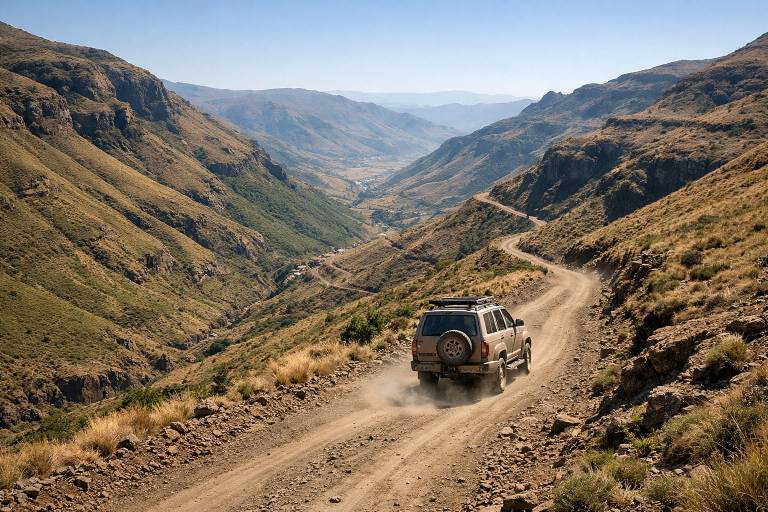
A sturdy 4x4 is essential for tackling Lesotho's steep, unpaved mountain roads.
Public minibus taxis run daily between Maseru and major towns like Leribe, Mokhotlong, and Qacha's Nek, typically costing M20–M50 ($1–3) per trip. They leave when full, pack tightly, and take longer than driving yourself, but they're reliable for main routes and give you a chance to chat with Basotho commuters. For shorter trips around Maseru, metered taxis and shared four-plus-ones (sedan taxis) wait at taxi ranks near the border and city center. Hitchhiking is common in rural areas, though you should offer to pay the driver M20–M30 for fuel.
Which travel eSIM works in Lesotho? Coverage, setup and data options
Lesotho operates on two main mobile networks offering 4G coverage in Maseru and the lowlands but dropping to 3G or no service in the highlands. Most international eSIM providers route through one of these local carriers, so coverage will mirror the underlying network. Plans typically start at 1 GB for short trips, scaling up to 10 GB or more for extended stays—useful if you're spending several days in remote areas like Sani Pass or Ts'ehlanyane National Park. Activation typically takes two minutes: scan the QR code before departure, toggle the eSIM as your data line when you land, and you're connected without hunting for a SIM vendor in Maseru.
Setup mirrors the process used for eSIM in Zanzibar or Namibia—add the profile in your phone's cellular settings, label it for travel data, and keep your home number active for calls. If your itinerary includes both Lesotho and South Africa, look for regional plans that cover both countries under one data pool. Highland lodges often lack reliable cell service entirely, so download offline maps and any essential documents in Maseru before heading into the mountains.
Do people speak English in Lesotho? Local languages and useful phrases
English use in towns and tourist areas
Yes, English is one of Lesotho's two official languages and is widely used in government, education, and tourism. You'll find that most people working in hotels, tour operators, and shops in towns like Maseru and popular trekking hubs speak English well. Road signs, official documents, and restaurant menus are typically in English, making navigation straightforward for US travelers.
That said, Sesotho is the mother tongue for nearly all Basotho and the dominant language in rural villages and markets. While you'll manage fine with English in tourist areas, learning a few Sesotho phrases goes a long way. Try "Lumela" (hello), "Kea leboha" (thank you), and "Sala hantle" (goodbye). Locals appreciate the effort, especially in mountain communities where English may be less common. If you're planning a regional trip, the same approach works across Southern Africa—just as you'd pick up local greetings when traveling in neighboring countries.
What traditional attire is worn in Lesotho? Basotho clothing and cultural etiquette
The most distinctive piece of Basotho clothing is the Basotho blanket, a thick wool wrap worn draped over the shoulders by men and women alike. Originally introduced by British traders in the 1800s, these blankets now carry deep symbolic meaning: designs, colors, and how they're worn indicate age, marital status, and social role. The conical straw hat called a mokorotlo—shaped like the peak of Qiloane mountain—is the national symbol and appears on the country's flag. You'll see herders and villagers wearing both daily, especially in rural highlands where temperatures drop sharply.
Men often pair blankets with trousers and rubber boots, while women may wear long skirts and headscarves beneath theirs. During ceremonies and festivals, expect vibrant patterns and layered textiles. Visitors aren't expected to wear traditional dress, but modest clothing is appreciated: avoid very short shorts or revealing tops, particularly in villages and when visiting homes. A polite greeting in Sesotho—Lumela (hello)—and asking permission before photographing people or their clothing goes a long way. Handshakes are common, and removing hats indoors shows respect.
Lesotho Travel FAQ: Currency, Payments, Tipping, Electricity and Packing
What currency does Lesotho use?
Lesotho uses the loti (LSL), pegged 1:1 with the South African rand. Both currencies circulate freely throughout the country, and you'll receive change in either. ATMs in Maseru, Leribe and other towns dispense maloti, though rural areas have limited access. Cards work in hotels and larger restaurants, but bring cash for markets, transport and mountain lodges. Vendors in border towns often quote prices in rand.
Is tipping expected in Lesotho?
Tipping is appreciated but not mandatory. In restaurants, 10% is standard for good service. Tip lodge staff 50–100 maloti per day, guides 100–150 maloti after a full-day tour, and pony trekking guides around 50 maloti. Petrol attendants expect 5–10 maloti. If someone helps with luggage or provides informal assistance, 20–30 maloti is appropriate.
Power plugs, voltage and charging
Lesotho uses 220V Type M plugs (three large round pins). South African Type D and C adapters sometimes fit, but bring a dedicated Type M adapter or universal model. Power cuts occur occasionally in rural areas, so pack a portable charger and keep devices topped up when staying outside Maseru.
What should you pack for Lesotho?
Layered clothing works year-round: temperatures swing sharply between day and night, even in summer. Pack a warm fleece or down jacket for highlands, a rain jacket for afternoon storms, sturdy hiking boots with ankle support, sun protection (UV is intense at altitude), and a hat. Bring any prescription medication—pharmacies stock basics but not specialty items. A headlamp is useful for lodges without backup generators.