

Best eSIM for Martinique 2026 — The best Martinique eSIM for 2026 fits your trip length, data habits, and phone. The cheapest headline price rarely tells the whole story. This guide compares 12 eSIM providers on Martinique coverage, price, plan size, validity, hotspot rules, and activation. Use it to weigh a short beach break against a longer island stay. Read the plan terms before you buy:
Choose a Martinique eSIM based on your itinerary, data needs, and whether your phone is unlocked and eSIM-compatible.
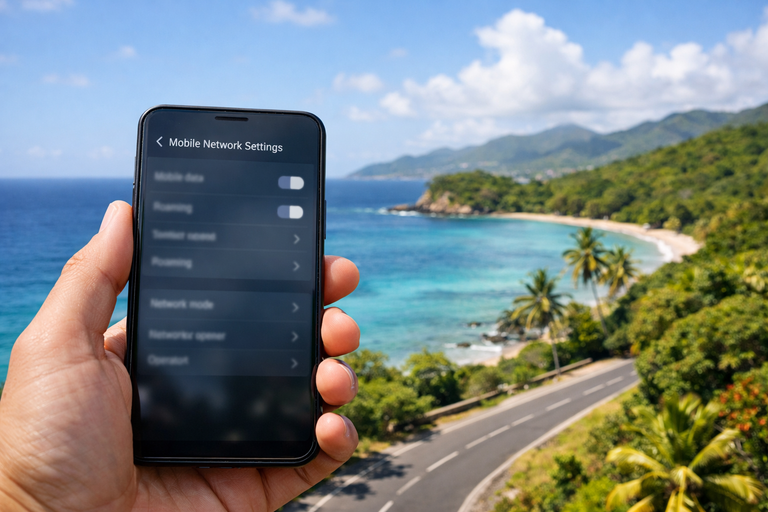
Choose a Martinique eSIM based on trip length, data needs, and whether your phone is unlocked and eSIM-compatible.
A travel eSIM can keep your phone connected around Martinique without swapping your home SIM.
a low price can hide a short validity window or a data-only plan with no calls.
Want one option to inspect first? Start with safariesim.com’s Martinique eSIM page. Then use the comparison below to test it against the other 11 providers on data allowance, validity, and coverage.
An eSIM works only when your phone supports it and is carrier-unlocked. Our guide to phones that support eSIM in 2026 walks through the settings path for major brands. Confirm compatibility before you pay for any plan. On a dual-SIM phone, keep your home line active for calls and send data through the travel plan.
Quick answer: Find the right Martinique eSIM plan for your trip
Three questions narrow the choice: How many days will you spend on the island? How much data do you use per day? Do you need to share your connection? Answer those first, then filter the 12 providers on this page.
Days on the ground. A five-day beach trip and a three-week stay need different validity windows. Days you never use are money spent for nothing.
Data per day. Maps, messages, and a few searches use far less than streaming, video calls, or photo uploads. Be honest about the traveler you are.
Hotspot and coverage. Confirm tethering is allowed and the plan covers the whole island, not one region, before you commit.
If you prefer one prepaid travel plan to a monthly contract, compare all twelve providers on cost per day and data included. Skip the sticker price. Divide the plan price by its validity in days, then ask how much of that allowance you will actually use on the island.
One last gate: the phone needs eSIM hardware and must be carrier-unlocked before you pay. A locked phone can accept the profile and then never register on a local network. Confirm both points before checkout.
2026 comparison table: SafarieSIM, Jetpac, Roamless, Orange Travel, GoMoWorld, Kolet, Eskimo, Global YO, Keepgo, BetterRoaming, eSIM4Travel, and Instabridge
The twelve providers fall into three buying models: fixed packages, pay-as-you-go credit, and app-managed passes. That structure often matters more than the headline price.
Provider | Buying model | Best fit |
|---|---|---|
SafarieSIM | Prepaid Martinique plan | Single-trip buyers |
Jetpac | Regional and global bundles | Island-hopping routes |
Roamless | Pay-as-you-go credit | Light, occasional use |
Orange Travel | Operator-branded eSIM | Buyers who prefer network brands |
GoMoWorld | App-managed global plans | One app across several trips |
Kolet | Fixed travel packages | Predictable data needs |
Eskimo | Time-limited plans | Short stays |
Global YO | Multi-country global plans | Martinique plus Europe |
Keepgo | Long-validity credit | Repeat visitors |
BetterRoaming | Per-trip packages | Business travel |
eSIM4Travel | Multi-network marketplace | Side-by-side comparison |
Instabridge | App eSIM with wifi access | Wifi-heavy users |
No fixed price holds all year. The same provider can quote very different amounts for 3 GB over 7 days versus 10 GB over 30 days. Currency conversion adds another variable. Compare cost per gigabyte per day, not the sticker number.
Whichever provider you shortlist, read its plan page before paying. Check three numbers: the allowance in gigabytes, the validity counted from activation rather than purchase, and whether the profile installs from a QR code or an app.
How we compared prices, data allowances, validity, coverage, speed, hotspot use, and support
We scored all 12 providers against the same seven-point checklist. The plan used was the one a typical 7- to 10-day visitor would buy.
Price was normalized to cost per gigabyte, not the headline sticker. We recorded whether a plan sells a fixed data bucket or a daily allowance. A cheap 20 GB plan that expires in 7 days is not comparable to a 10 GB plan valid for 30.
Validity was checked from activation, not purchase. That distinction catches travelers who install before departure. Coverage was judged on the local partner network named in each provider’s own documentation, not on a regional map.
For speed, we looked for a stated high-speed cap before throttling. Hotspot use was logged as allowed, blocked, or capped, and we noted whether tethering draws from the same data pool. Support was assessed on published channels and stated response times.
The same scoring sheet went to all twelve providers. The comparison reflects consistent criteria, not the order brands appear in a list.
Which eSIM offers the best coverage and speeds in Martinique?
Coverage in Martinique depends on the local network a plan routes onto, not the brand printed on the QR code. Nearly every provider in this comparison roams on Orange Caraïbe or Digicel, the two networks with real reach across the island.
Orange generally holds up best on the coast road between Fort-de-France and Sainte-Anne and in the interior hill towns. Digicel is competitive around Le Marin and the built-up south. Based in Les Trois-Îlets or Le Diamant? You will notice little difference between the two.
Treat “5G” in a plan description as marketing until you confirm the underlying network. 5G has rolled out in parts of Fort-de-France and Le Lamentin, but most visitors spend their time on 4G/LTE. That is enough for navigation, messaging, and photo uploads. Crowds at Les Salines on a Sunday affect your speed far more than a provider’s advertised peak.
The practical answer: pick a plan that names its local network partner and states a clear data allowance. Avoid an ambiguous “unlimited” that hides a throttling threshold. Then confirm the plan covers the whole island, not one region, before you buy.
How much eSIM data do you need for a Martinique vacation?
Plan on 3–5 GB for a one-week Martinique trip. Step up to 10 GB only if you tether a laptop, stream video, or back up photos over cellular every day.
Trip or usage pattern | Recommended data | When to choose it |
|---|---|---|
One-week Martinique trip | 3–5 GB | Typical vacation use |
Heavy cellular use | 10 GB | Tethering a laptop, streaming video, or backing up photos over cellular every day |
For most one-week visits, 3–5 GB is enough; move to 10 GB only for data-heavy daily use.
Trip usage | Recommended data | When it fits |
|---|---|---|
Typical one-week trip | 3–5 GB | Most Martinique vacations lasting one week |
Higher-use trip | 10 GB | Tethering a laptop, streaming video, or backing up photos over cellular every day |
For most one-week stays, 3–5 GB is enough; move to 10 GB only for regular tethering, streaming, or cellular photo backups.
Match the allowance to how you actually travel:
Light, 1–3 GB: maps, restaurant searches, messaging, and a handful of photo uploads. Enough for a week of driving between Fort-de-France and the southern beaches.
Moderate, 5 GB: adds daily social posting, ferry and tour bookings, and a few short video calls home.
Heavy, 10 GB or more: hotspot to a second device, automatic cloud backup, or evening streaming.
Two habits shrink usage fast: download offline maps before you fly, and switch off background app refresh for anything you don’t need. Villa and hotel Wi-Fi on the island can be sluggish, so keep 500 MB spare for the booking you can’t afford to miss. Weighing plan sizes against price? This guide to cheap, fast travel data in 2026 helps. Check validity too: a 7-day plan wastes money on a 12-day stay.
Which eSIM fits your trip: short stays, long stays, heavy data, or a tight budget
Match validity to your dates before data size. A plan that expires unused wastes money just as surely as one that runs dry mid-trip.
Short trips (under a week): take the smallest one-week allowance on offer, often 1–3 GB. Buy a second plan only if you actually run dry.
Long stays (two weeks or more): a single 30-day plan almost always costs less per day than stacking two short ones.
Heavy data use: prioritize the largest allowance with hotspot sharing included. That combination matters more than headline speed when you tether a laptop.
Budget travelers: compare cost per gigabyte rather than total price. Accept a data-only plan since you will not make local calls anyway.
Prepaid travel data is sold in fixed tiers, so match the allowance to your dates. A seven-day tier suits a short break. A 30-day tier almost always costs less per day across a two-week stay. Current allowances and validity windows are listed on each provider’s plan page.
Will your phone work with a Martinique eSIM?
Only if it has eSIM hardware, is carrier-unlocked, and has not been reported lost or stolen. Dial *#06#. If the screen lists an EID alongside the IMEI, the phone can store an eSIM profile. No EID means no eSIM, whatever the plan promises.
Then look for the software switch: an “Add eSIM” or “Add data plan” option under your mobile network settings. Phones bought on carrier installment plans are the usual failure point. A locked handset will accept the Martinique profile and then never register on a local network.
Regional variants are the second trap. Some markets sell the same model with eSIM removed, so the model name alone proves nothing. Confirm the exact model number in the settings menu.
Plan for two lines. A Martinique eSIM runs beside your physical home SIM. Keep your own number active for bank verification texts while data runs through the travel plan.
How do you buy, install, and activate an eSIM for Martinique?
Buy the plan online before departure. Install the profile on home Wi-Fi. Switch the line on only after you reach Martinique. Installation needs a stable internet connection; activation needs local network signal.
Check the phone first. It must be carrier-unlocked and eSIM-capable. That is a hardware requirement, not an app. Our breakdown of cheap, fast international data plans covers what to verify before paying.
Buy direct from the provider. Choose the data amount and validity in days. Pay by card, and the QR code arrives by email, usually within minutes.
Install at home. Open Settings, then Cellular (or Connections). Tap Add eSIM and scan the QR code. Label the line “Martinique” so you can find it later.
Activate on arrival. Turn the Martinique line on. Enable data roaming for that line only, and set it as the default for mobile data. Leave your home line on for calls and texts, with its data roaming switched off.
SafarieSIM’s Martinique eSIM follows the same three steps: buy, scan, activate. Test the line before you leave the airport. If nothing loads, recheck which line is set as the default for data.
Do Martinique eSIM plans include calls, texts, hotspot access, or a local number?
Most Martinique eSIM plans are data-only. Data runs on the eSIM. Calls and texts stay on your primary SIM through your home plan or a messaging app that uses that data connection.
Three inclusions vary by provider. Check each before checkout.
Calls and texts: a handful of carrier-linked plans add a French number with voice minutes and SMS, usually at a clear premium over data-only pricing.
Hotspot: tethering is commonly allowed, but some providers cap it at one connected device or exclude it on unlimited-style plans.
Local number: rare across the twelve providers compared here. A French number helps with restaurant bookings and deliveries. Otherwise, a data plan covers the trip.
Set your home SIM as the default for voice and the eSIM as the default for data. Turn on data roaming for the eSIM line only. That clean split leaves your everyday number free to receive calls and bank verification texts while travel data runs over the local network.
Travel eSIM vs physical SIM: Which option is better in Martinique?
For most trips of five days or more, a travel eSIM is the better buy in Martinique. Set it up before departure, keep your home line live for bank verification texts, and skip the ID check and counter queue.
A physical SIM still wins in three cases. Your phone has no eSIM chip. You are staying a month or more and want a French number for local calls. Or you prefer walk-in help in Fort-de-France if something fails. French prepaid SIMs require photo ID, so carry your passport.
Both routes ride the same towers. Orange Caraïbe and SFR reach the coastal towns well; signal thins in the rainforest below Mount Pelée. Setup time, not coverage, is the real dividing line.
If your phone is carrier-unlocked and eSIM-ready, buy before you fly. SafarieSIM’s Martinique eSIM is one option you can sort out before the airport. That beats hunting for a kiosk after a long flight.
Common activation, roaming, and connectivity problems—and how to fix them
Nearly every Martinique eSIM failure comes down to one of three settings: the travel line is not selected for mobile data, data roaming is switched off, or the handset is carrier-locked.
A Martinique plan works by roaming onto local networks. Roaming must stay enabled on the eSIM line even though you never left home coverage. See “no service” after landing? Toggle airplane mode for 30 seconds. Then confirm the eSIM is the active data line and the primary line’s data is off to avoid charges.
Connected but slow: switch network selection from automatic to manual and pick a different operator.
No eSIM menu at all: the device may be carrier-locked or lack eSIM hardware. Check our 2026 phone compatibility list before buying another plan.
Stuck on “activating”: install over stable Wi-Fi before departure. Delete and re-add the profile if it stalls.
Data fails with a strong signal: enter the provider’s APN manually under cellular settings.
Martinique eSIM FAQ: Pricing, Activation, Coverage, Top-Ups, and Regional Travel
The questions that come up most before checkout: what a plan costs, when to install it, where coverage holds, how top-ups work, and what happens if you cross to Guadeloupe. Price tracks data and validity, so a light one-week plan sits far below a 10 GB plan valid for a month. Install at home on Wi-Fi, activate on arrival. Coverage follows Orange Caraïbe and Digicel, and thins in the rainforest interior below Mount Pelée. Top-up terms differ by provider, and a Martinique-only plan stops working the moment you leave the island.
How much does a Martinique eSIM cost in 2026?
Light, short-validity plans cost far less than 10 GB-plus packages valid for a month. Price per gigabyte drops as the allowance rises. Judge each plan on total cost against days of validity and hotspot rules, not the headline number alone.
Should you install the eSIM before you fly?
Install it at home over reliable Wi-Fi, then let it activate on first connection in Martinique. Setup takes only a few minutes. Doing it at the departure gate leaves no room to troubleshoot.
Does coverage reach beyond Fort-de-France?
Coastal towns, cruise ports, and the main roads linking them are well served. Signal thins in the rainforest interior and on the upper slopes of Mount Pelée. Download offline maps before hiking.
Can you top up or extend a plan?
Most providers let you add data or extend validity from your account. A few require a fresh purchase instead. Confirm top-up terms before committing to a long stay.
Will the same eSIM work in Guadeloupe or elsewhere in the Caribbean?
Only if you bought a regional Caribbean plan rather than a Martinique-only one. A single-country plan stops working the moment you leave. Check the country list first.
Before buying, confirm your handset appears in our guide to phones that support eSIM. Then use the comparison table above to match a plan to your trip length.
