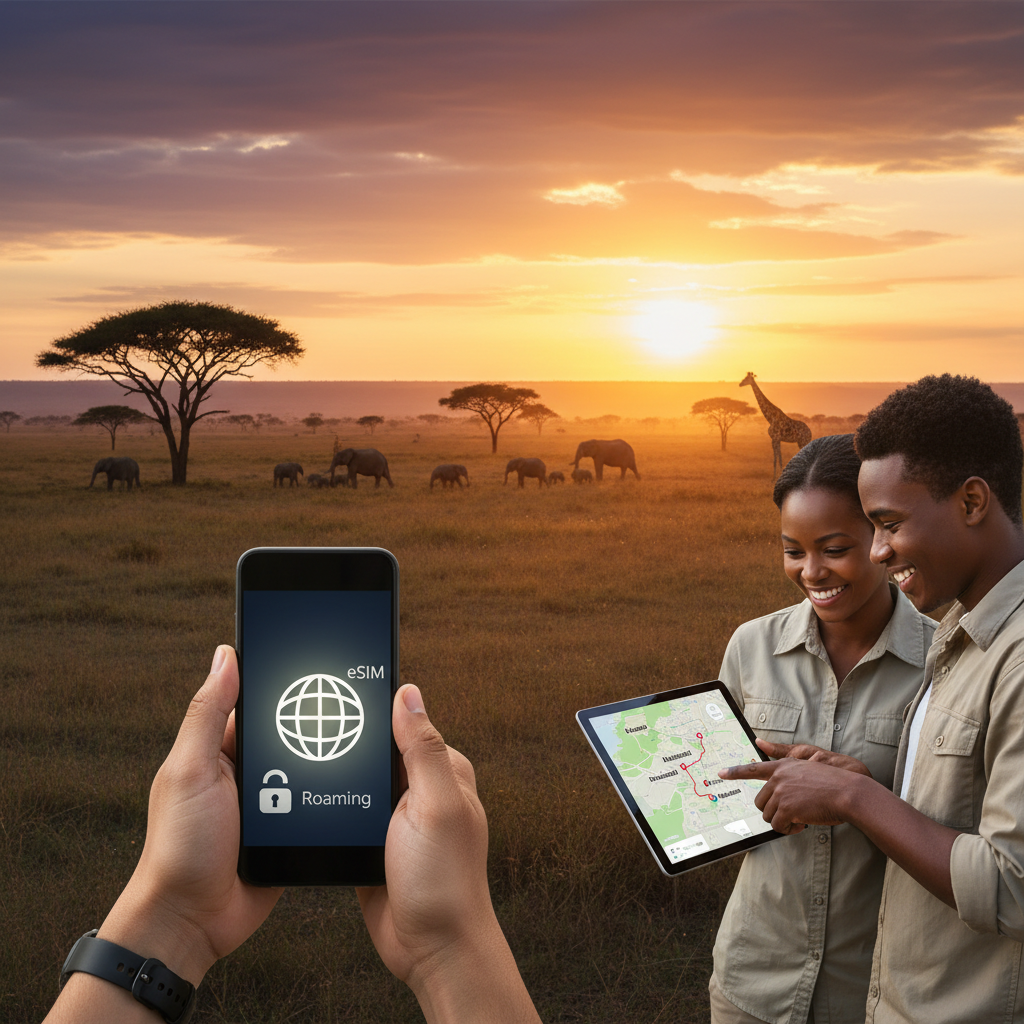
Key takeaways:
eSIMs use local data rates instead of roaming fees—save $100+ on a typical Kenya trip
Safaricom and Airtel networks reach major safari routes, cities and most national parks
Install your eSIM before you fly; it activates on arrival in Kenya
Roaming works for short business trips when your employer pays or you need your regular number for calls
Physical SIM cards still work if your phone doesn't support eSIM
Quick Comparison: Cost, Convenience, Coverage and Flexibility
Factor | eSIM | International Roaming |
|---|---|---|
Cost | $5–$50 for 1GB–20GB, depending on duration | $10–$15 per day, often with data caps |
Setup | Install at home via QR code or app; activates on arrival | Automatic when you land; may require carrier opt-in |
Coverage | Uses Safaricom or Airtel; strong in cities and parks | Depends on your home carrier's roaming agreements |
Flexibility | Choose data allowance and validity; top up if needed | Fixed daily rate; limited control over usage |
Phone Number | Keeps your home number for iMessage and WhatsApp; new number for local calls if needed | Retains your regular number for voice and SMS |
A 10-day safari with roaming costs $100 to $150 in daily fees. An eSIM with 10GB runs $20 to $30. You control exactly how much data you buy. Need more? Top up through the app without leaving the Serengeti.
How International Roaming Charges Work in Kenya
Land in Kenya with your home SIM and roaming enabled, and your phone connects to a local network through your carrier's partner agreement. Your home operator bills you for that access. The charges hit your regular monthly statement.
Most European, North American and Australian carriers charge a flat daily rate for Kenya roaming. You pay on any day you use data, make a call or send a text. Some plans cap daily data at 500MB or 1GB before throttling speeds. Others sell "roaming passes"—often $50 for a week of limited data. Either way, Kenya roaming adds up fast.
A few operators include Kenya in broader roaming zones, but that's rare outside premium business plans. Even "included" roaming often throttles speeds or limits you to 2G networks. Loading a map or uploading game drive photos becomes nearly impossible.
Roaming suits short trips where convenience matters more than cost. A 48-hour Nairobi business meeting covered by your employer? Roaming keeps your regular number active without setup. A week-long safari or multi-country East Africa trip? The costs make roaming a poor choice next to local data.
Kenya eSIM Data Packages and What You Get for Your Money
Kenya eSIM plans range from 1GB packages for short city visits to 20GB or more for extended safaris. Most offer 7-day to 30-day validity. The data works nationwide once you're on a local network.
A 1GB to 3GB plan for a week costs $5 to $10. Mid-range options—5GB to 10GB for two weeks—run $15 to $25. Larger packages with 20GB or more, useful for uploading safari videos or working remotely from a lodge, cost $30 to $50. These prices reflect major eSIM providers serving Kenya, though rates shift with promotions and currency fluctuations.
Most Kenya eSIM packages are data-only. You get mobile internet but no local phone number for voice calls. That works for most travellers—WhatsApp, FaceTime and similar apps handle calls and messages over data. Even travellers on extended safaris find data-only plans sufficient for staying connected. Need a local number to call safari lodges or book domestic flights? A few eSIM providers offer plans with a Kenyan number at slightly higher cost. The best travel eSIM for Kenya depends on your coverage priorities and data needs.
Mobile data in Kenya runs on Safaricom or Airtel networks. Safaricom dominates with the widest coverage, reaching remote parks and the coast. Airtel offers good city and town speeds but thinner rural coverage. When buying a Kenya travel eSIM, check which network the provider uses. If your itinerary includes the northern conservancies or Tsavo East, choose Safaricom-based eSIMs.
Best eSIM Options for a Kenyan Safari: SafarieSIM, Airalo, Holafly and Nomad
SafarieSIM specializes in Africa travel, with Kenya plans optimized for safari routes and national parks. The platform offers Safaricom network access—reliable internet in Kenya's game reserves and remote lodges. Plans range from 3GB for short trips to 20GB for longer stays. You can top up mid-trip if you run low. Setup takes minutes through their app. Customer support responds quickly if issues crop up.
Airalo is a global eSIM marketplace with multiple Kenya options. Their local Kenya eSIM connects to Safaricom. Regional Africa packages let you use data across Kenya, Tanzania and Uganda if you're crossing borders. Prices are competitive. The app makes installation straightforward. Airalo suits travellers who want flexibility and a proven track record across dozens of countries.
Holafly offers unlimited data plans for Kenya. Sounds appealing until you read the terms. After a daily threshold—often 1GB to 2GB—speeds drop to 2G. The "unlimited" label misleads. Holafly works for WhatsApp and maps but struggles with video calls home or uploading large photo albums from the Mara. Mid-range pricing. Safaricom network.
Nomad provides straightforward Kenya eSIM plans with transparent data limits and no speed throttling. Their packages work on Safaricom's network. You can buy additional data through the app if needed. Clean interface. Clear pricing. A solid option if you want simplicity over flashy features.
All four support major phone models, but always check compatibility before buying. Visiting multiple countries—Kenya and Tanzania, or Kenya and Uganda? Look for regional eSIM plans covering East Africa instead of buying separate country plans.
Mobile Coverage on Safari Routes, in National Parks and in Remote Areas
Safaricom's network covers Nairobi, Mombasa, Kisumu and the main highways between them. Inside national parks, coverage varies. The Maasai Mara has solid signal in central areas near lodges and camps, especially around Mara River crossing points. Amboseli National Park offers decent coverage near Amboseli Serena and Ol Tukai Lodge, but signal weakens toward Observation Hill and the southern swamps.
Tsavo East and Tsavo West are hit-and-miss. Expect signal near gates and major lodges, but long park stretches have no coverage. Driving between Voi and Manyani? Plan on hours offline. Lake Nakuru National Park and the surrounding town have good connectivity. Lake Naivasha and Hell's Gate rely on signal from nearby Naivasha town, reaching parts of the parks but not the remote western sections.
The Kenyan coast—Diani Beach, Watamu, Malindi—has strong coverage from both Safaricom and Airtel. Fast data for uploading beach photos and booking boat trips to marine parks. Lamu Island has signal in Lamu Town and Shela, but smaller islands and mangrove channels drop to edge-of-network speeds or lose signal entirely.
Northern Kenya tests any network. Samburu, Laikipia and Turkana areas see Safaricom reach main conservancies and lodges, but coverage is thin and unreliable. Visiting remote conservancies or the far north? Expect days offline. Download maps, guides and emergency contacts before leaving areas with signal.
Combining a Kenyan safari with Tanzania or Uganda? Your Kenya eSIM won't work across the border unless you bought a regional plan. eSIM for Tanzania requires a separate purchase or a multi-country package covering both nations.
Cheapest eSIM Options for Kenya and Multi-Country Africa Travel
Budget priority? Start with smaller data packages. A 1GB plan for a week costs $5 to $8 from most providers. Covers basic needs: maps, messaging and web browsing. You won't stream video or upload every photo in real time, but you'll stay connected for navigation and communication. Run out? Top-ups usually cost $5 to $10 per gigabyte.
Regional eSIM plans offer better value for multi-country trips. An East Africa package covering Kenya, Tanzania and Uganda typically costs $20 to $30 for 5GB valid across all three countries. Cheaper than buying separate Kenya and Tanzania eSIMs if you're crossing borders. Some providers offer continent-wide Africa plans, useful if your itinerary includes Kenya, Egypt, South Africa or Morocco. Higher upfront cost but cheaper than stacking individual country eSIMs.
Watch for promotions. Providers run discounts around peak travel seasons—June to October for Kenya safaris—and you often find 20% off or bonus data. Sign up for email lists or check provider websites a few weeks before your trip. Black Friday and year-end sales bring steep eSIM plan discounts.
Avoid "unlimited" plans that throttle speeds after a low threshold unless you've confirmed the daily limit suits your usage. A 10GB plan with full-speed data throughout beats a 30-day "unlimited" plan dropping to 2G after 1GB per day if you're uploading photos or video calling.
eSIM vs Physical SIM for Travelling in Kenya and Across Africa
Physical SIM cards remain widely available in Kenya. Find them at the airport, in mobile carrier shops in Nairobi and Mombasa, and at supermarkets and petrol stations nationwide. Safaricom and Airtel sell prepaid SIMs with data bundles. The process takes about 15 minutes once you present your passport for registration.
Physical SIMs suit travellers whose phones don't support eSIM or who prefer buying connectivity on arrival. Prices are similar to eSIM plans—expect 500 to 1,500 Kenyan shillings for a SIM and initial data bundle. Main drawback: time spent queuing at the airport or finding a carrier shop, plus you need to swap out your home SIM. You lose easy access to your regular number unless your phone has dual SIM slots.
eSIMs eliminate the physical swap and let you install everything before travel. You keep your home SIM in place. iMessage, WhatsApp and other services tied to your regular number keep working. Someone calls your home number while you're on safari? It can ring through over Wi-Fi calling or forward to voicemail.
For East Africa travel—Kenya, Tanzania, Uganda, Rwanda—eSIMs offer more flexibility. Instead of buying and swapping physical SIMs every border crossing, you install a regional eSIM working in all four countries. Physical SIMs require new purchase and registration in each nation, eating travel time and costing more overall.
How to Check Compatibility, Install Your eSIM and Control Data Use
Most iPhones from XS onwards support eSIM, as do recent Samsung Galaxy models, Google Pixels from Pixel 3 and newer Huawei, Oppo and Motorola flagships. To confirm compatibility, go to Settings, look for Cellular or Mobile Data, and check for an option to add a data plan or eSIM. On Android, the path varies by manufacturer but usually lives under Settings > Connections > SIM card manager.
Unsure? Dial *#06# on your phone. If an EID number appears alongside your IMEI, your device supports eSIM. No EID means you need a physical SIM instead.
Installing an eSIM takes minutes. After buying your plan, the provider sends a QR code by email or displays it in their app. Open your phone's eSIM settings, select Add Data Plan or Add eSIM, and scan the code. Your phone downloads the profile and prompts you to label it—name it "Kenya" or "Safari" so you remember which plan. The eSIM won't activate until you land in Kenya and connect to the local network. Once active, data flows immediately.
To control data use and avoid burning through your allowance, turn off automatic app updates and background refresh for apps you don't need on safari. Disable auto-play for videos on social media. Download maps and guides over Wi-Fi at your lodge before heading into the parks. Most phones let you set data warnings or limits in Settings—configure a 500MB daily cap if you're on a tight budget.
iPhones and Android devices let you choose which SIM handles data. Set your Kenya eSIM as the primary data line and keep your home SIM active for calls and texts if you're expecting important messages. This dual-SIM setup means you stay reachable on your regular number while using cheap local data for everything else.
Disadvantages of eSIMs and Situations Where Roaming May Be Preferable
eSIMs aren't perfect. Phone lost, stolen or damaged on safari? Transferring your eSIM to a replacement device is harder than swapping a physical SIM card. Most providers let you reinstall an eSIM, but the process requires contacting support and waiting for a new QR code. A physical SIM just pops into your backup phone.
Some older phones and budget Android models still lack eSIM support. Carrying a device from 2017 or earlier? You're stuck with physical SIMs or roaming. Check compatibility before booking—buying an unusable eSIM wastes money and leaves you scrambling for alternatives at the airport.
Roaming makes sense for very short trips where convenience justifies cost. In Nairobi for a 24-hour layover or quick two-day conference? Paying $10 to $15 in roaming fees is simpler than installing an eSIM. You land, your phone connects, you're online. No setup. The cost stings, but time savings matter when your trip measures in hours.
Roaming also suits situations where keeping your regular phone number active for voice calls is critical. Travelling for work and clients or colleagues need to reach you on your usual number? Roaming keeps that line open without forcing you to juggle two SIMs or rely on app-based calling. Some corporate plans include roaming at no extra charge, making it the obvious choice if your employer covers connectivity.
Finally, roaming provides a safety net in countries with complex SIM registration rules or limited eSIM provider coverage. Kenya is well-served by eSIM options, but if your itinerary includes countries where eSIM availability is patchy, roaming guarantees at least basic connectivity everywhere your home carrier has agreements.
FAQ
Is it better to use roaming or an eSIM?
An eSIM is better for most Kenya trips. You pay local data rates instead of $10 to $15 per day in roaming fees and control exactly how much data you buy. Roaming suits short business trips where your employer covers costs or when you need your regular number for voice calls.
Which eSIM works best in Kenya?
SafarieSIM and Airalo both offer reliable Kenya eSIM options on the Safaricom network—strong coverage in national parks and cities. Nomad and Holafly are solid choices too, though Holafly's unlimited plans throttle speeds after a daily threshold. Pick based on your data needs and trip length.
What are the disadvantages of using an eSIM?
eSIMs are harder to transfer if your phone is lost or damaged, and not all devices support the technology. Some travellers find setup less intuitive than buying a physical SIM on arrival. For most people, these drawbacks are minor compared to cost savings and convenience.
Is eSIM better for international roaming?
An eSIM replaces international roaming by giving you local data rates. Instead of paying your home carrier's roaming fees, you buy data directly from a local network at a fraction of the cost. eSIMs excel on multi-country trips—one regional plan covers Kenya, Tanzania and Uganda instead of juggling roaming rates across borders.
Do I need to register my eSIM in Kenya?
No. eSIMs from international providers handle registration on your behalf. When you buy a Kenya eSIM, the provider completes network registration and your eSIM activates automatically when you land. No carrier shop visit or passport presentation needed.
Can I use WhatsApp and iMessage with an eSIM?
Yes. WhatsApp, iMessage, FaceTime and other messaging apps work perfectly over your eSIM's data connection. You can keep your home SIM active in your phone's second slot, so messages and calls to your regular number still come through while your eSIM handles data.
How much data do I need for a two-week Kenya safari?
Most travellers use 5GB to 10GB over two weeks for maps, messaging, social media and uploading photos. Plan to video call home daily or upload high-resolution videos? Budget 15GB to 20GB. Download maps and guides over Wi-Fi at your lodge to reduce data use in the parks.
Will my eSIM work in Tanzania if I cross the border from Kenya?
Only if you bought a regional East Africa eSIM covering both countries. A Kenya-only eSIM stops working when you leave Kenya. Visiting Tanzania? Buy a Tanzania eSIM separately or choose a multi-country plan before your trip.